

A Systematic Approach to Fixing Slow China Access for Overseas Websites
If your overseas site loads slowly in China, the problem usually isn't your server. This guide explains how to solve it by looking at the real network path, covering CDN, origin routing, network lines, and architecture.

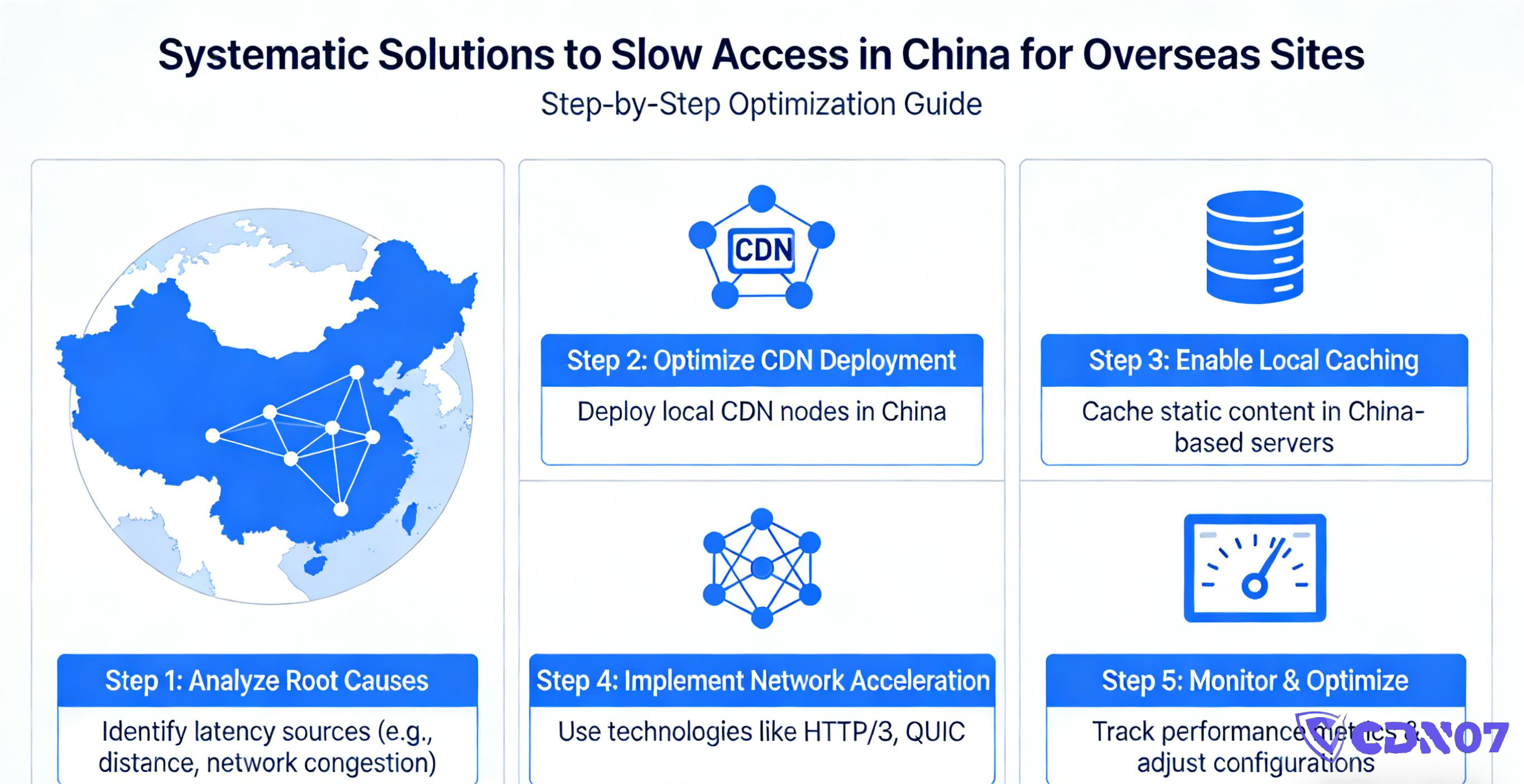
If you run an overseas website and have users in China, you've almost certainly run into the same issue: It works fine everywhere else, but slows to a crawl for users in China.
What's even more frustrating is that you've probably tried all the "usual fixes": upgrading server specs, moving to a more expensive data center overseas, implementing a CDN, tweaking cache settings.
Only to find out: It didn’t work, or the improvement didn’t last.
With over a decade in this industry, I can tell you this with certainty: When access from China is slow, 90% of the time it's not a server performance issue—it's a "road" problem.
In this article, I won't just teach you to "adjust parameters." Instead, I'll walk you through why access from China is slow, where the bottlenecks are, and how to fix it systematically.
1. Let's clear up a major misconception: Overseas servers aren't actually slow.
Most people's first thought is: "Is my server just not powerful enough?"
But if you think about it, you'll notice something counterintuitive: Users in the US or Europe访问 → fast. Users in Japan or Singapore访问 → still okay. Users in China → latency spikes, slow first byte, occasional timeouts.
If it were truly a server performance problem, it wouldn’t selectively slow down only for Chinese users.
The real issue is: the access path.
2. What path does traffic actually take when accessing an overseas site from China?
If you don't understand this, every optimization attempt afterwards will miss the mark.
When a user in China visits an overseas site, the request typically goes through:
- Local ISP egress (China Telecom / China Unicom / China Mobile)
- International gateway nodes (extremely congested)
- Overseas carrier networks
- Data center entry point
- Your server
Out of these, step 2 is by far the most unstable.
International gateways have one defining characteristic: congested, indirect, and unpredictable.
Especially during peak hours, you'll see: even when the physical distance isn't great, the actual RTT is absurdly high, with random packet loss and jitter.
This is why many people experience: "Sometimes it's blazing fast, other times it feels like the internet is broken."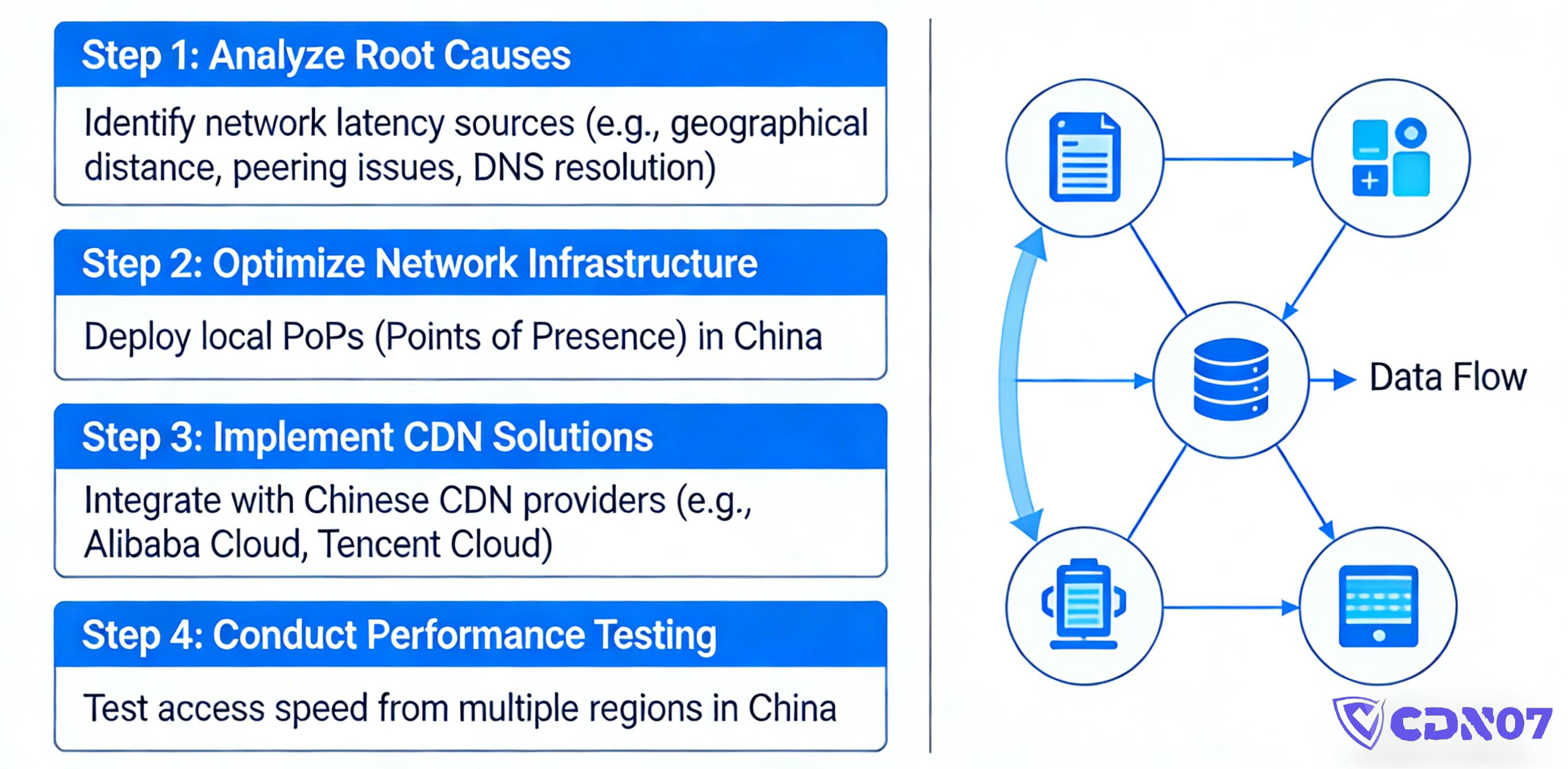
3. Why does "just adding any CDN" usually fail to solve slow China access?
This is the most common pitfall I see.
Many CDN solutions for overseas sites are fundamentally optimized for users outside of China.
Their design logic is:
- European user → European CDN node
- American user → American CDN node
But for a user in China, what often happens is:
- DNS resolves to the "closest overseas node"
- But that cross-border path is not optimized for China traffic.
The result: The cache might hit, but the first byte is still slow, and dynamic requests lag just as much.
Put simply: A CDN shortens the distance from your server to its node, but it doesn't fix the "road conditions" between China and the rest of the world.
4. To fix slow China access, you really need to solve these three things
If you view the problem as a system instead of a single point, the direction becomes clear.
1️⃣ Where is the entry point?
The first hop for Chinese users is critical.
- Does traffic go directly overseas?
- Does it land in Hong Kong first?
- Is it entering a "friendly" network zone?
Choose the wrong entry point, and no amount of later optimization can make up for it.
2️⃣ Which route does traffic take?
Not all international network lines are created equal.
- Standard BGP
- Optimized routes
- ISP-specific friendly routes
You don't need to memorize these terms. Just remember this: The route determines stability, not just bandwidth size.
3️⃣ Is your origin routing method sensible?
Even with a middle-layer CDN, many sites still have inefficient origin traffic paths. Typical issues include:
- Node-to-origin traffic using the public internet
- Uncontrollable origin routing paths
- Traffic being killed during attacks or congestion
Designing your origin routing is often more important than the CDN itself.
5. Three truly effective systematic solutions
Below are the three most reliable and frequently used approaches from my experience in recent years.
It's not about "which one is best," but which one fits your site's stage of growth.
Solution 1: Overseas Origin + China-Friendly CDN (Most Common)
This is the first step for most overseas sites.
The core idea is simple:
- Origin server remains overseas
- CDN nodes placed as close to China as possible
- Optimized DNS resolution and origin routing
Advantages:
- Relatively cost-effective
- Minimal architectural changes
- Great for content sites, download portals
Clear disadvantages:
- Limited improvement for dynamic requests
- Still affected by international gateway congestion during peak hours
Best for: Content sites, news portals, brochure sites.
Solution 2: Regional Entry Point + Optimized Overseas Origin Routing (Most Effective)
This is my personal recommendation for best results. The typical structure:
- Chinese user → Regional entry point (e.g., Hong Kong)
- Regional entry point → Private line / Optimized route → Overseas origin
The benefits are direct:
- Chinese users don't need to connect directly overseas
- International links only carry "internal" traffic
- Significantly improved stability
With this architecture, the difference in first-byte time and stability is very noticeable.
Best for: SaaS platforms, APIs, transaction-based services.
Solution 3: Multi-Entry Layered Architecture (Mature Solution)
This approach is more suited to mid-large scale sites.
Simply put:
- Mainland China / Hong Kong / Overseas entry points
- Different user groups routed to different entries
- "Traffic splitting" built into the architecture
Advantages:
- Strong resilience
- Minimal impact from single-point failures
- Enables granular traffic management
But the trade-offs are real:
- Complex architecture
- Higher operational costs
- Requires more expert support
Best for: High-traffic sites with complex business logic.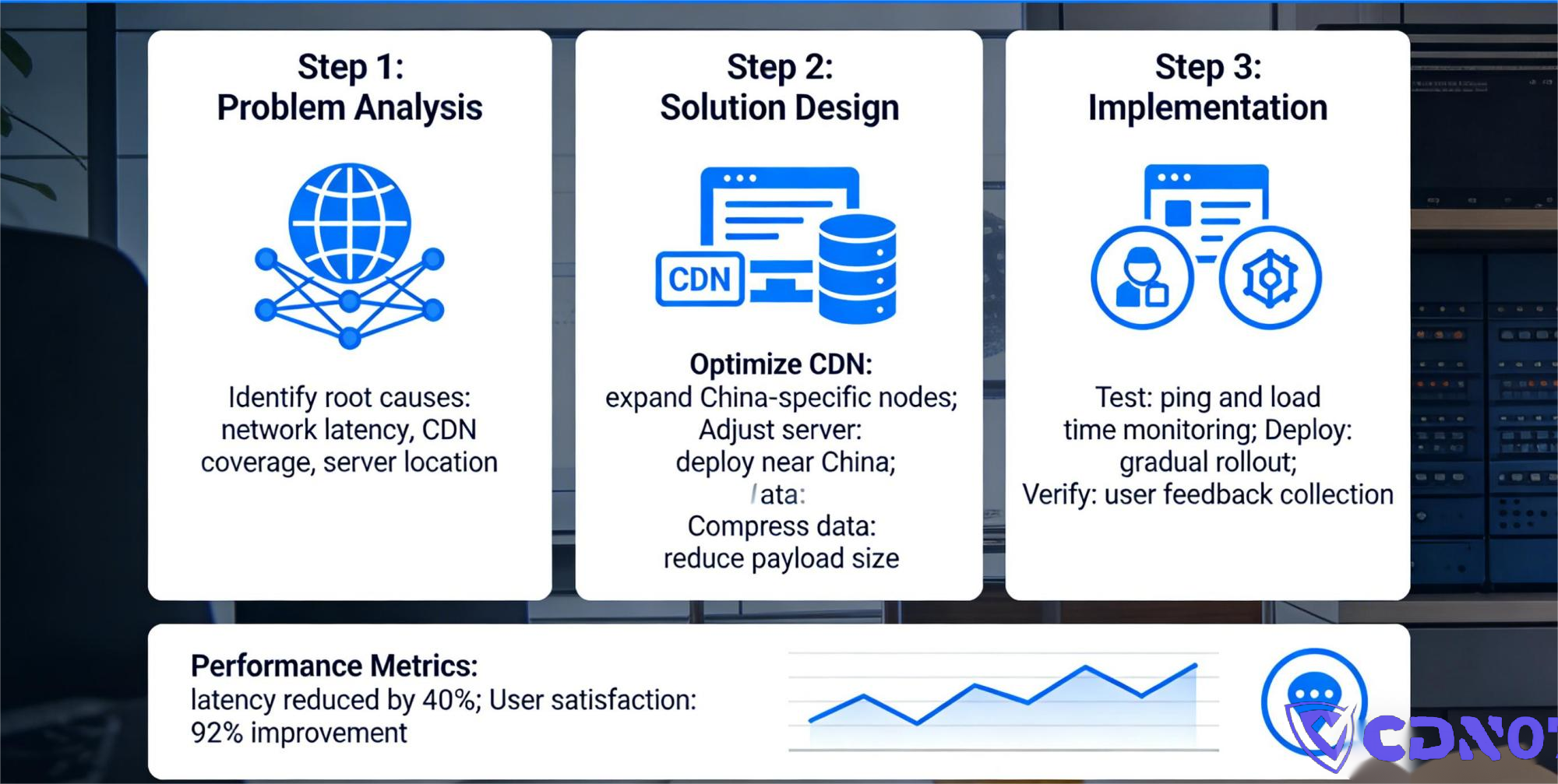
6. Why is a Hong Kong node often a key piece of the puzzle?
You'll notice I keep mentioning "Hong Kong."
The reasons are simple:
- Geographically close
- Relatively open network environment
- Friendly access from Mainland China
But a word of caution: Just "having a Hong Kong node" isn't enough.
What matters isn't just "is it in Hong Kong," but:
- Is the Hong Kong node the actual entry point?
- Can it directly handle Chinese traffic?
- Is the origin routing a direct path?
Otherwise, Hong Kong is just a "transfer station," not a solution.
7. Why do many optimizations work at first, then slow down again later?
Many people encounter this. There are usually three reasons:
- International gateway congestion returns
- Traffic increased, but architecture wasn't scaled up
- CDN or line policies changed
This is exactly why I always stress: Don't expect a one-time fix to solve everything.
A truly stable solution must be:
- Adjustable
- Scalable
- Observable
8. Practical advice for different types of sites
Finally, here's a very practical summary of recommendations.
If you run a content site / blog / download portal
- Prioritize CDN
- Maximize cache strategies
- No need for complex architecture from the start
If you run an API / SaaS / business system
- Must consider an entry point node
- Absolutely optimize origin routing
- Stability is more important than peak speed
If you run a game / real-time service
- Latency is the #1 metric
- Architecture needs to be layered
- Consider protection and acceleration together
Final Thoughts
Slow China access for overseas sites is never just a "single-point problem."
It's the combined result of: network, route, architecture, and traffic management.
If you only focus on server parameters, bandwidth size, or CDN pricing, this problem will keep coming back.
But once you approach it from a "systematic path" perspective, you'll find: Slowness can be designed away.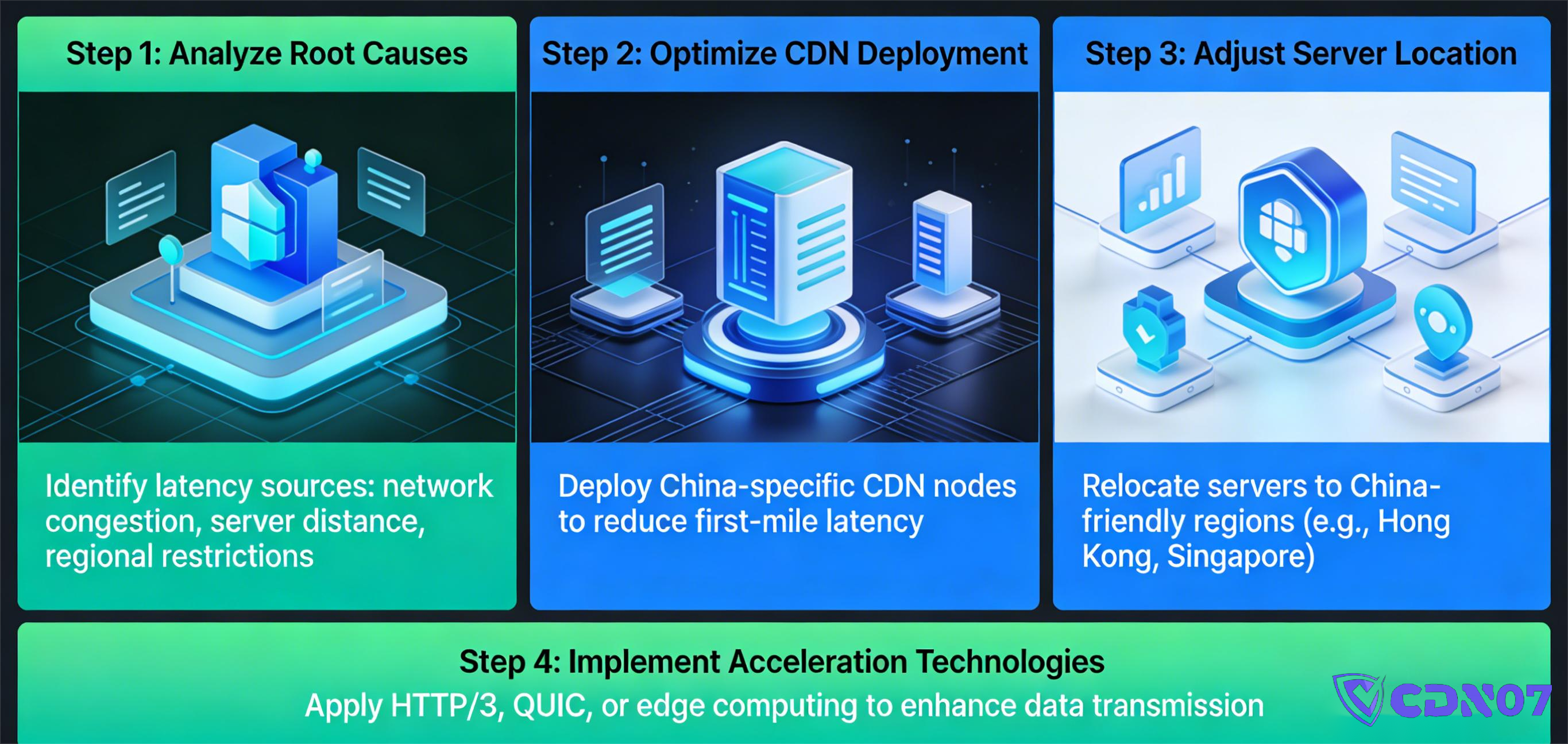
Frequently Asked Questions:
Q1: Why is my overseas website so slow to open in China?
A:
Put simply, it's not that your site is "poorly built," but that the cross-border network step itself is slow.
Data coming from the US or Europe has to pass through international gateways, backbone networks, and then into Chinese ISPs. Congestion on any segment will cause lag.
It's very normal for your site to feel fine overseas but slow for Chinese users.
Q2: I'm already using an international CDN like Cloudflare or Akamai. Why is access from China still slow?
A:
Because for Chinese users, they often aren't the "optimal solution."
Many international CDNs have few nodes in China, use indirect routes, or rely on congested public gateways. They may offer "global acceleration," but the China segment isn't truly optimized.
Hence the result: fast elsewhere, slow in China.
Q3: How much does hosting my server in the US or Europe really affect users in China?
A:
The impact is very direct.
Physical distance + cross-border lines = inherent base latency.
Even with the best server performance, if data has to travel halfway around the globe, you can't avoid slow first byte, slow TLS, long white screen times.
Q4: Is slow China access a "cross-border network problem" or my website's problem?
A:
90% of the time it's a network path problem, not a website problem.
You can diagnose it this way:
- Access is normal from overseas
- Consistently slow from multiple locations in China
- No improvement when changing browsers or devices
Then the bottleneck is almost certainly in the cross-border link, not your code or server config.
Q5: For an overseas site to be faster for Chinese users, is a Chinese CDN mandatory?
A:
Not necessarily.
If you can complete ICP licensing and comply with regulations, a Chinese CDN is indeed the fastest option.
But the reality is, many overseas sites don't meet these requirements.
In that case, the more common approach is:
A combination of your main overseas site + a dedicated acceleration service / optimized-route CDN for China traffic.
Q6: Without ICP licensing or using servers in China, is there any way to improve speed for Chinese users?
A:
Yes, and this is the path most overseas sites take.
The core idea isn't to "enter China," but to:
- Get close to China (e.g., Hong Kong, Singapore)
- Use China-friendly network lines (CN2, optimized BGP)
- Avoid the most congested, packet-loss-prone paths
It might not be as fast as a domestic site, but it can turn "very slow" into "usable."
Q7: Do CN2 direct connect and optimized BGP really help with China access?
A:
They do, but only if you're getting the "real deal."
Genuine CN2 and high-quality BGP can significantly reduce latency and packet loss.
But the market is full of "CN2 in name only" and "marketing BGP" with limited effect.
That's why two services both labeled "CN2" can deliver very different experiences.
Q8: What are the most common pitfalls when optimizing an overseas site for China access?
A:
The most frequent mistakes:
- Focusing only on "protection specs," ignoring actual network lines
- Testing only from overseas, not from within China
- Assuming "adding a CDN guarantees speed"
- Being lured by cheap plans that crash during peak hours
A solution that actually performs stably is proven through real-world testing, not just by reading docs.
Share this post:
Related Posts

Which Websites Are a Good Fit for CDN07's DDoS-Protected CDN, and How Does It Compare with Cloudflare?
Compare CDN07 and Cloudflare for websites serving users in Mainland China, including connectivity, D...

How Much Does a DDoS-Protected CDN Cost per Month? Plans, Legitimate Traffic, and Additional Charges
The monthly cost of a DDoS-protected CDN depends on the plan allowance, legitimate traffic usage, pr...

How to Choose a DDoS-Protected CDN: Workloads, Network Connectivity, and Protection
Choosing a DDoS-protected CDN takes more than comparing mitigation capacity and monthly price. This...