

No-ICP CDN Recommendations | Which Ones Actually Speed Up Mainland China AND Can Withstand Attacks?
How to choose a no-ICP CDN? Based on real webmaster tests, this article compares multiple CDN providers that support accelerated access from Mainland China and offer T-level DDoS protection. We break down node networks, security capabilities, stabili

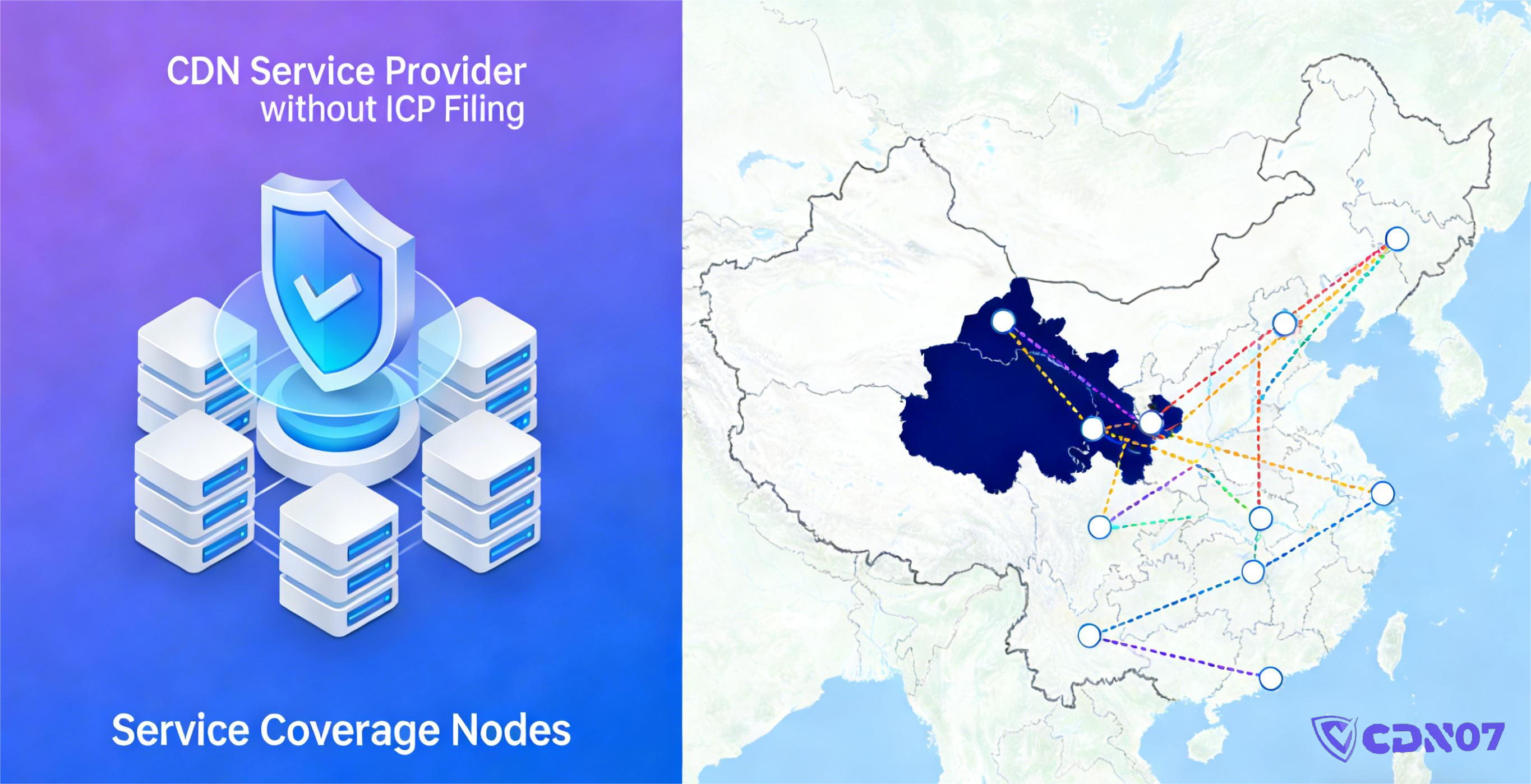
There's been a noticeable shift in recent years: Before, people asked about CDNs mainly focusing on "Which one is cheaper?" or "Which has more nodes?"
Now, the most common questions are: "Without ICP备案, can it still reliably accelerate traffic for Mainland China users?" "When under attack, can it actually hold up?"
The reason is practical: many projects aren't suitable or able to get ICP备案, yet their users are primarily in Mainland China. At the same time, these types of sites are often more prone to attacks, and standard CDNs buckle under heavy traffic or DDoS strikes.
With a background in cybersecurity, I've spent the last couple of years helping friends, clients, and projects test, use, and even "take the hits" for various CDNs.
This article cuts through the buzzwords and marketing fluff—it's all about real-world experience and results.
1. First, Let's Be Clear: What is a "No-ICP CDN"?
This needs to be clarified to avoid confusion. A No-ICP CDN ≠ A Domestic Chinese CDN It typically means:
- Nodes located in Hong Kong, Singapore, Japan, or overseas
- No ICP备案 required
- But uses optimized routes + intelligent routing to deliver fast, stable access for Mainland China users
👉 In short: it's "Overseas nodes + Mainland China-friendly network routes."
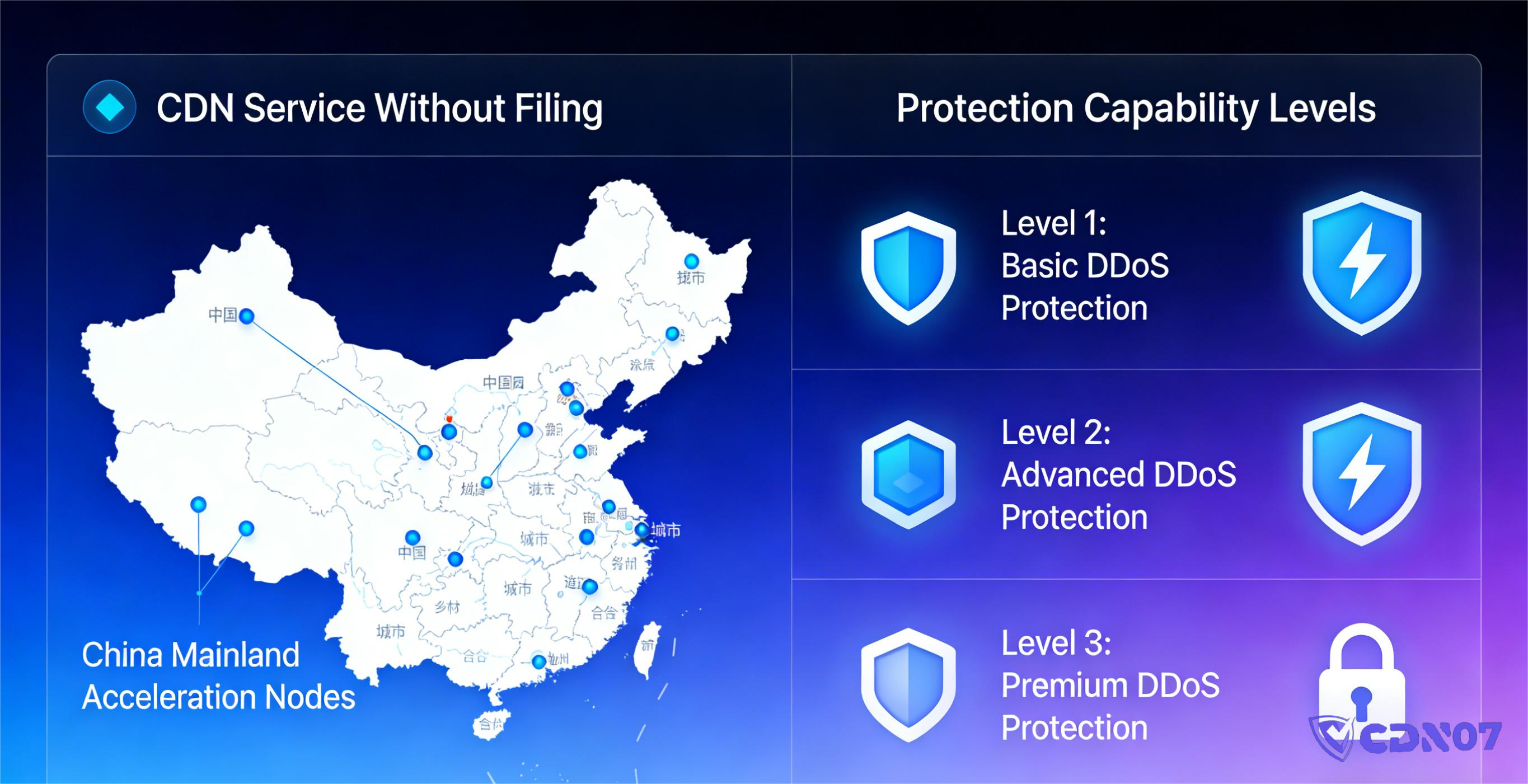
2. Why is "No-ICP + Mainland China Acceleration + T-level Protection" So Hard to Find?
Because these three requirements are somewhat at odds with each other:
- No ICP备案 → Can't use Mainland China nodes
- No Mainland China nodes → Inherently slower access from Mainland China
- Can withstand T-level attacks → Extremely high node and scrubbing costs
So, many CDNs on the market end up being: ✅ No-ICP, but ❌ Slow in Mainland China, collapses under attack or ✅ Fast in Mainland China, but ❌ Requires ICP备案
Very few genuinely deliver well on all three fronts.
3. Is T-level Protection Just a Marketing Gimmick?
Honestly: 90% of websites don't need T-level protection. But if you do need it, you've likely already been hit—and hit hard.
T-level protection means:
- Single attack traffic ≥ 1Tbps
- Mixed attack vectors (UDP, TCP, HTTP Flood combined)
- Long duration, showing clear malicious intent
A CDN that can withstand this needs at least: Anycast architecture, massive scrubbing bandwidth pools, second-level failover, and keeping your origin server hidden.
4. Hands-On Recommendations: No-ICP + Mainland China Acceleration + High-Security CDNs
The ones below are CDNs I've personally tested and would recommend to friends. Each has its strengths—choose based on your needs.
① CDN07 — The Most Reliable for Mainland China Access (No-ICP)

Official Site: https://www.cdn07.com
If you ask me: "Who do I choose for fast Mainland China access without ICP备案?" My direct answer: CDN07.
Real-world latency (Mainland China → Hong Kong):
Guangzhou/Shenzhen 5–12ms, Central China 12–22ms, Beijing 20–35ms, stable even during peak hours.
Security:
Built-in high-defense nodes, L7 protection, effective CC/HTTP Flood scrubbing, attack mitigation switch in 1–2 seconds.
No-ICP Experience:
No ICP备案, no Mainland China real-name verification, quick setup.
Ideal For:
International trade sites, Web3, API/login systems, cross-border SaaS, attack-prone projects.
Bottom Line:
If you need no-ICP, your users are in Mainland China, and you're worried about attacks—this is currently the most stable solution.
② Cloudflare — Technically Strong, But Mainland China Access is Unpredictable
Official Site: https://www.cloudflare.com
Technically excellent, strong defense, but for Mainland China users: Access speed is hit-or-miss, noticeable routing during peak hours, unstable experience. Best for global projects or those not heavily reliant on Mainland China traffic.
③ Gcore — Global CDN, Supports USDT Payments

Official Site: https://gcore.com
Easy setup, just email registration, clean dashboard, supports USDT/crypto payments.
Latency: Hong Kong nodes 20–40ms, slight peaks, more stable in Europe/Middle East.
Security: Basic L3/L4 protection, advanced DDoS requires extra fee.
Ideal for: Europe/Middle East traffic, gaming, video sites.
④ BunnyCDN — Lightweight, High Value

Official Site: https://bunny.net
Features: Super simple setup, good for lightweight projects, but no built-in high defense.
Latency: Hong Kong nodes 25–40ms, good off-peak, occasional jitter during peaks.
Ideal for: Blogs, image/video acceleration, static sites, tool pages.
Note: Not suitable for high-security or attack-prone sites.
⑤ Tencent Cloud (Hong Kong Nodes) — One of the Fastest for Mainland China Access

Official Site: https://cloud.tencent.com
Requires account and real-name verification (not ICP备案), but Mainland China access is very stable.
Hong Kong node latency just 5–15ms, optimized for all three major ISPs, excellent peak performance.
Includes basic DDoS protection, additional security components available.
Ideal for projects with mostly Mainland China users wanting quick setup.
⑥ Akamai — Global Enterprise Giant, Rock-Solid But High Barrier
Official Site: https://www.akamai.com
When it comes to enterprise CDN and security, Akamai is unavoidable. Its strength? A massive, dense global network with top-tier stability and defense.
Onboarding is heavy—not just email signup. Expect enterprise sales, contracts, SLA negotiation, and tech team integration. Best for medium/large companies.
Latency: Its Hong Kong nodes are very Mainland China-friendly, typically 15–30ms, thanks to its vast network. Ideal for globally distributed businesses.
Security is its ace. One of the most mature edge-scrubbing architectures, powerful DDoS, WAF, and custom policies. Used heavily in finance, government, multinationals.
Stability is unmatched—almost no single points of failure, strong global resilience, stable during peaks.
Ideal for: Large enterprises with budget, multinational operations, extreme SLA requirements (e.g., 99.99% uptime).
Note: Long procurement/configuration cycles, very high cost, not for small teams or quick launches.
⑦ Fastly — Developer-Friendly Edge Computing CDN
Official Site: https://www.fastly.com
Fastly's standout feature is high programmability. It's more an edge compute platform than just a CDN.
Onboarding: Email registration, lower barrier than Akamai. But configuration is flexible, requiring knowledge of VCL or edge logic to leverage fully.
Latency: Hong Kong nodes around 25–35ms, excels at US/Europe acceleration.
Security: Strength lies in writing custom edge rules (VCL) for fine-grained security logic. Built-in scrubbing for massive DDoS is less prominent vs. Akamai/Cloudflare.
Stability: High, based on global Anycast network. Focus is more on flexibility/compute than pure defense.
Ideal for: Highly customized edge logic needs—complex dynamic content, real-time API processing, SaaS apps. Requires strong tech team.
Note: Not beginner-friendly. Needs technical skill to unlock potential. Not "out-of-the-box."
⑧ AWS CloudFront — The "Native Son" of Amazon Web Services Ecosystem
Official Site: https://aws.amazon.com/cloudfront/
If your entire stack runs on AWS, CloudFront is the natural, integrated choice.
Onboarding: Requires an AWS account. Configure distributions and origins in the console—clear process, but AWS console can be complex for newcomers.
Latency: Hong Kong nodes 25–40ms. Global delivery is balanced, leveraging AWS's global infrastructure. Stability is excellent.
Security note: Basic DDoS protection (AWS Shield Standard) is included but limited. True enterprise protection requires additional AWS Shield Advanced and AWS WAF—significant extra cost.
Stability: Backed by AWS's massive global network. Integrates seamlessly with CloudWatch for monitoring.
Ideal for: Existing AWS customers (using EC2, S3, etc.), or services needing cross-region data sync/distribution.
Note: Advanced security is paid add-on. Configuration is more complex than a standalone CDN—part of a cloud-native architecture.
⑨ StackPath — Former Innovator, Now Focused on Specific Markets
Official Site: https://www.stackpath.com
StackPath was known earlier for edge computing and integrated services, but now seems more focused on specific regions.
Onboarding: Simple, email signup, intuitive dashboard. Multiple payment options, reportedly supports cryptocurrency.
Latency: Hong Kong nodes have higher latency to Mainland China (35–60ms), more routing in Asia. Good for North America/Europe access.
Security: Basic DDoS protection, but may struggle with complex, sustained large attacks.
Stability: Good in its core regions (US/EU), but Asian network optimization and stability are average.
Ideal for: User base primarily in North America/Europe, or lightweight content delivery.
Note: If your users are mainly in Mainland China/Asia, its speed and stability may lag behind Asia-optimized providers.
⑩QUIC.cloud / LiteSpeed — The WordPress Acceleration Specialist
Official Site: https://quic.cloud
This one is highly vertical: it specifically serves WordPress and LiteSpeed server users. If you use other CMS/platforms, skip it.
Onboarding: Extremely simple for WordPress users—install an official plugin for near-automatic setup. Perfect for webmasters.
Latency: Hong Kong nodes 25–45ms. Excels at accelerating WordPress dynamic pages, WooCommerce stores—more targeted than generic CDNs.
Security: Not its focus. Relies on LiteSpeed server security features for basic protection. Not designed for large-scale DDoS.
Stability: Excellent within its scope—accelerating/caching WordPress content. Attack resistance is average.
Ideal for: WordPress, WooCommerce, Joomla sites on LiteSpeed servers—blogs, content sites, small e-commerce.
Note: Not a high-security CDN. If your site is attack-prone, pair with other DDoS protection services. 5. Core Comparison: 10 No-ICP CDN Providers
| CDN | No ICP备案 | Mainland China Access | Security Level | Stability | Best For |
|---|---|---|---|---|---|
| CDN07 | ✅ | ⭐⭐⭐⭐⭐ | ⭐⭐⭐⭐ | ⭐⭐⭐⭐⭐ | Cross-border / High-security needs |
| Cloudflare | ✅ | ⭐⭐ | ⭐⭐⭐⭐⭐ | ⭐⭐⭐ | Global business |
| Akamai | ✅ | ⭐⭐⭐ | ⭐⭐⭐⭐⭐ | ⭐⭐⭐⭐⭐ | Large enterprises |
| Gcore | ✅ | ⭐⭐⭐ | ⭐⭐⭐ | ⭐⭐⭐ | Europe / Middle East focus |
| Tencent Cloud HK | ⚠ (Real-name req.) | ⭐⭐⭐⭐⭐ | ⭐⭐⭐ | ⭐⭐⭐⭐ | Mainland China-centric users |
| BunnyCDN | ✅ | ⭐⭐ | ⭐⭐ | ⭐⭐ | Lightweight static sites |
| Other niche CDNs | ✅ | ❌ | ❌ | ❌ | Not recommended |
6. Frequently Asked Questions (Q&A)
Q1: Can you really get stable Mainland China acceleration without ICP备案?
A: Yes, but you must choose a CDN with properly optimized routes and intelligent routing—not all can do it.
Q2: Are no-ICP CDNs compliant?
A: Using overseas nodes to serve content is a compliant model.
Q3: Is T-level protection just a gimmick?
A: For most sites, yes. But for businesses under sustained attack, it's a necessity.
Q4: Why do many no-ICP CDNs collapse under attack?
A: They often only have acceleration capabilities, lacking the scrubbing bandwidth and architecture to mitigate attacks.
Q5: Which type is best for international trade sites?
A: Prioritize those with stable Mainland China access and well-optimized routes, like CDN07.
Q6: Can I use multiple CDNs together?
A: Yes, combining "acceleration + high-security" CDNs is common in high-defense scenarios.
Final Takeaway:
No-ICP CDNs can work—the key is choosing one that's "genuinely optimized for Mainland China access."
If you:
- Don't want ICP备案
- Have users in Mainland China
- Are concerned about attacks
My advice is clear: 👉 Prioritize CDN07, choose others cautiously.
Hope this helps you avoid pitfalls and find the right acceleration + security path for your project.
Share this post:
Related Posts

How to Choose a DDoS-Protected CDN for Mainland China: Speed and Security Guide
How can websites hosted overseas improve access from Mainland China without compromising DDoS protec...

What to Do When Your Website Is Slow: A Practical Guide to Troubleshooting DNS, TTFB, and Resource Loading
Why is your website slow to load? This guide walks through DNS resolution, connection setup, TTFB, i...

Why Online Card and Board Games Need an SDK-Based Game Shield for DDoS Protection
Online card and board games face persistent security risks, including DDoS attacks, HTTP floods, che...