

What Is CDN Acceleration? A Complete Guide to How Website Speed Optimization Really Works
CDN acceleration is a network optimization technology that caches and delivers website content through globally distributed edge servers located closer to users. By reducing latency, improving page load speed, and minimizing the workload on origin servers, CDN technology plays a critical role in modern web performance. This guide explains how CDN acceleration works, including DNS resolution, edge

When people first hear the term “CDN acceleration,” it often sounds highly technical. At the same time, they usually associate it with making websites load faster.
Some even assume that a CDN is simply a “speed booster” for a website. While that's partially true, it doesn't tell the whole story.
A CDN can absolutely improve website performance, but the technology behind it goes far beyond simple acceleration.
In this guide, we'll break everything down and explain:
- What CDN acceleration actually is
- How a CDN makes websites load faster
- Why a website can still feel slow even after implementing a CDN
I. What Is CDN Acceleration?
Let's start with the simplest definition: CDN (Content Delivery Network) is a technology that distributes website content across a global network of servers, placing content closer to users for faster delivery.
Put simply, a CDN doesn't make your server faster—it makes your users closer to your content.
For example, imagine your website is hosted in the United States while visitors are accessing it from China. The data must travel thousands of miles across international networks, which naturally introduces latency.
However, when a CDN is enabled, users in China no longer need to connect directly to your U.S.-based server.
Instead, their requests may be served from nearby locations such as Hong Kong, Japan, or Singapore, resulting in significantly faster load times.
II. How CDN Acceleration Works
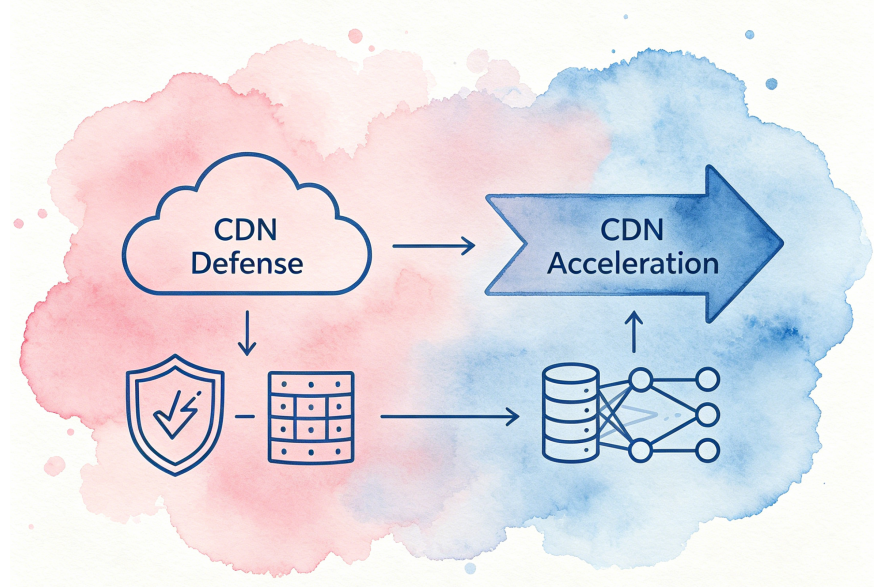
CDN acceleration is not a single process—it's a complete system composed of several technologies working together. Let's look at each component.
1. DNS Resolution: Determining Where Users Connect First
When a user enters a website address, the first step isn't loading the website itself—it's performing a DNS lookup.
At this stage, the CDN intelligently directs the visitor to the nearest or most efficient edge server.
For example:
- Users in Shanghai → Hong Kong edge node
- Users in Beijing → Japan edge node
- Users in Europe → Germany edge node
2. Edge Nodes: The Closest Cache Servers to End Users
The foundation of every CDN is its network of edge nodes. These servers are strategically deployed around the world in locations such as Hong Kong, Singapore, Tokyo, Los Angeles, and Frankfurt.
Their primary purpose is to store copies of website content.
For example: images, JavaScript files, CSS files, videos, and other static assets.
When a visitor requests content, the CDN checks whether the edge server already has the data.
If the content is available, it is delivered immediately. If not, the edge server retrieves it from the origin server.
3. Caching Mechanism: Why CDN Technology Improves Speed
Caching is the core technology behind CDN performance optimization.
The process typically works like this:
First request: User → CDN edge server → Origin server → Content delivered → Cached on edge server
Subsequent requests: User → CDN edge server → Cached content delivered instantly
This is why the speed difference can be substantial.
4. Origin Fetching: When Does a Request Reach the Origin Server?
Not every request is served directly from cache. The CDN may contact the origin server under the following circumstances: expired cache, dynamic content, or requests for resources that have not yet been cached.
The purpose of origin fetching is to ensure users always receive the most up-to-date content.
5. Intelligent Traffic Routing: Finding the Fastest Path
Advanced CDN platforms use intelligent routing systems that continuously evaluate network conditions.
These systems automatically determine which node offers the best performance, which route is most stable, whether congestion exists, and how traffic should be distributed in real time.
III. Why Does a CDN Make Websites Faster?
The answer comes down to three key factors:
1. Shorter distances: Data no longer needs to travel across continents.
2. Distributed traffic: Requests are spread across multiple servers instead of overwhelming a single origin server.
3. Cached resources: Frequently requested content is delivered instantly without repeated processing.
In short, a CDN doesn't accelerate the server—it optimizes the path between users and content.
IV. Why Is My Website Still Slow After Using a CDN?
This is a common question, and several factors may be responsible:
1. Poor cache hit rate: Requests frequently bypass the cache and return to the origin server.
2. Excessive dynamic content: Login systems, payment gateways, and API requests typically cannot be fully cached.
3. Low-quality CDN infrastructure: Some providers experience congestion, packet loss, or inconsistent latency during peak traffic periods.
4. Slow origin server performance: A CDN improves delivery efficiency but cannot fix inefficient server-side applications or database bottlenecks.
V. What Types of Websites Benefit from CDN Acceleration?
Virtually any website can benefit from a CDN, including:
✔ Corporate websites ✔ Global eCommerce stores ✔ Online gaming platforms ✔ Mobile applications ✔ API services ✔ Content-driven websites
The benefits become even more noticeable when users are geographically distributed, international traffic is significant, or the website serves large amounts of images and video content.
VI. What's the Difference Between a Standard CDN and a DDoS-Protected CDN?
Many people confuse these two services.
| Type | Primary Function |
|---|---|
| CDN Acceleration | Improve website performance and delivery speed |
| DDoS-Protected CDN | Traffic acceleration combined with cyberattack protection |
Today, many enterprise-grade solutions integrate acceleration, security, and intelligent routing into a single platform.
VII. Typical Use Cases for Solutions Like CDN07
Taking CDN07's DDoS-Protected CDN as an example, these platforms typically extend traditional CDN capabilities with features such as global traffic scheduling, DDoS mitigation, CC attack protection, origin server masking, and intelligent route optimization.
Common use cases include:
Global business operations, online gaming platforms, cross-border eCommerce websites, and API-driven service architectures.
VIII. Frequently Asked Questions
1. What is CDN acceleration?
CDN acceleration is a technology that caches website content across a global network of servers, allowing users to access data from locations closer to them and improving loading speed.
2. Can a CDN really make a website faster?
Yes. The performance improvements are especially noticeable for static resources and visitors accessing the site from different geographic regions.
3. What's the difference between CDN acceleration and upgrading a server?
A server upgrade increases processing capacity, while a CDN improves content delivery efficiency and network performance.
4. Why is my website still slow after enabling a CDN?
Common causes include low cache efficiency, poor-quality CDN nodes, or slow response times from the origin server.
5. Can a CDN accelerate all types of content?
No. Dynamic requests such as login authentication, payment processing, and personalized API calls generally cannot be fully cached.
6. Does a CDN affect SEO?
When properly configured, a CDN will not harm SEO. In fact, faster page loading speeds often contribute positively to search engine rankings and user experience metrics.
7. How do I choose between a standard CDN and a DDoS-protected CDN?
If your primary goal is faster website performance, a standard CDN may be sufficient. If you also need protection against cyberattacks, a DDoS-protected CDN or an integrated security solution is the better choice.
Final Thoughts
At its core, CDN acceleration is not about making servers faster. It's about redesigning how data travels across the internet so users can access content more efficiently.
The problem it solves isn't computational performance—it's network distance and delivery efficiency.
For today's websites:
- Users are more geographically distributed than ever before
- Traffic is increasingly global
- Cyberattacks are becoming more frequent
As a result, CDN technology has evolved from a simple performance enhancement tool into a fundamental component of modern internet infrastructure.
Understanding how a CDN works ultimately means understanding how the internet delivers data to users around the world.
Share this post:
Related Posts

How to Choose a DDoS-Protected CDN for Mainland China: Speed and Security Guide
How can websites hosted overseas improve access from Mainland China without compromising DDoS protec...

What to Do When Your Website Is Slow: A Practical Guide to Troubleshooting DNS, TTFB, and Resource Loading
Why is your website slow to load? This guide walks through DNS resolution, connection setup, TTFB, i...

Why Online Card and Board Games Need an SDK-Based Game Shield for DDoS Protection
Online card and board games face persistent security risks, including DDoS attacks, HTTP floods, che...