

Game SDK Shield vs. High-Defense IP: Which One Should You Choose?
A Game SDK Shield and a high-defense IP are not the same type of security solution, yet many game development teams often confuse the two when choosing a protection strategy. A high-defense IP is primarily designed to mitigate large-scale traffic attacks, while a Game SDK Shield goes further by protecting the origin server, securing game protocols, defending against CC attacks, and improving game

Security issues are something every online game will eventually have to deal with. Some projects get attacked within the first week after launch. Others operate for several months before becoming a target.
Some games may run smoothly for a long time, only to start experiencing frequent issues during major events, tournaments, or the launch of a new server. When that happens, operations teams are often given two recommendations:
One option is to deploy a high-defense IP. The other is to integrate a Game SDK Shield.
And that's when the big question comes up.
Game SDK Shield vs. High-Defense IP: Which One Should You Choose?
When development teams first encounter these two solutions, it's easy to assume they're basically the same.
After all, both are designed to protect against attacks. So why not just choose either one? In reality, their underlying approaches are completely different. Choosing the wrong solution can mean wasting money and potentially running into ongoing architectural and security issues later.
In this guide, we'll take an in-depth look at the differences between a Game SDK Shield and a high-defense IP from several perspectives, including technical architecture, attack protection, gaming experience, and operational costs.
If you're working on:
- Card games
- Mobile games
- MMORPGs
- MOBA games
- International games
- H5 games
It's worth reading this guide before making a decision. If we had to sum it up in one sentence:
A high-defense IP answers the question, "How do we protect the server when it's under attack?" A Game SDK Shield answers the question, "How do we keep attackers from finding the server in the first place?"
These are fundamentally different approaches. You could even think of them as two different generations of security solutions.
Once you understand this distinction, everything that follows becomes much easier to understand.
What Exactly Is a High-Defense IP?
Let's start with the traditional approach. A high-defense IP is essentially a traffic scrubbing service that sits between users and the origin server.
The normal access flow is: Player → High-Defense IP → Game Server
The attack flow is also: Attack Traffic → High-Defense IP → Game Server
When an attack occurs, the high-defense IP identifies malicious traffic, filters it, and then forwards legitimate traffic to the origin server.
Throughout this process, both players and attackers are essentially accessing the same entry point.
That's why the biggest value of a high-defense IP is simple: it takes the hit on behalf of the server.
Think of it as putting a bulletproof vest on your server. When someone attacks, the protective layer absorbs the impact.
Why Was the High-Defense IP Model So Popular?
Back in the PC gaming era, this was one of the simplest and most effective security solutions available.
It's quick to deploy, requires minimal changes, and is relatively affordable. It's especially effective for:
Game websites, login servers, payment interfaces, and API services.
For these scenarios, the results can be significant. Many gaming companies have relied on high-defense IPs for more than a decade, and they have successfully addressed a wide range of security challenges. That's why many projects still consider a high-defense IP their first-choice solution today.
But Problems Started to Emerge
As attack techniques have become more sophisticated, traditional high-defense IP solutions have revealed several inherent limitations.
The most obvious one is: the origin server still exists.
A high-defense IP simply sits in front of the server. The real server is still there behind it. If an attacker manages to discover the origin server's IP address, they may be able to bypass the protection node and attack the server directly.
This is known in the industry as: origin server exposure.
It's also one of the reasons why some projects can still be taken down even after purchasing high-defense IP protection.
CC Attacks Are Becoming Increasingly Difficult to Defend Against
DDoS attacks are relatively straightforward to understand. The basic idea is to overwhelm a target with massive amounts of traffic.
But in recent years, one of the fastest-growing threats has been CC attacks. The traffic generated by these attacks can look almost identical to legitimate player activity.
Attackers continuously send requests to:
Login interfaces, matchmaking services, room interfaces, and leaderboard APIs.
As server resources are continuously consumed, traditional high-defense IP solutions may not be well equipped to handle this type of application-layer attack.
The result is a common scenario: the server is still technically online, but players are already experiencing severe lag.
The Problem of IP Exposure
Many game projects encounter the same situation. They switch to a new high-defense IP, only to come under attack again a few days later.
Why? Because attackers aren't necessarily targeting the high-defense IP. They're looking for the real IP address of the origin server. As long as the origin server remains exposed, the attacks may never truly stop.
So, What Is a Game SDK Shield?
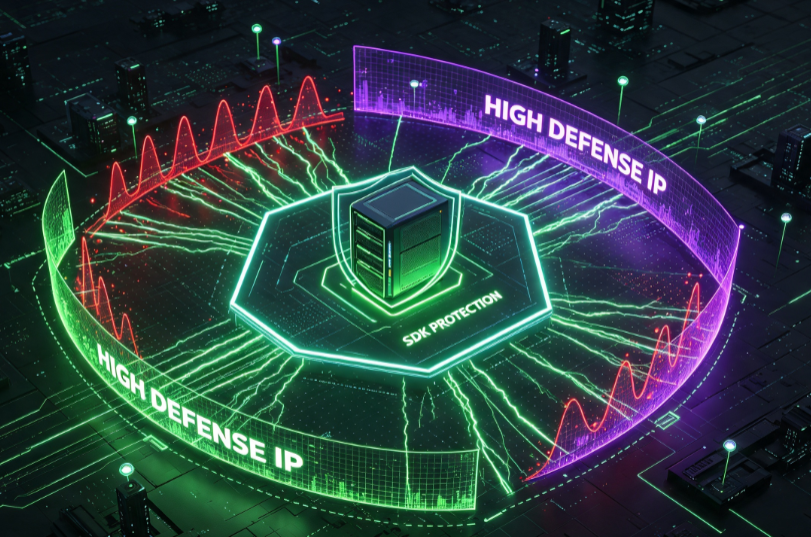
The Game SDK Shield was developed specifically to address these problems. The biggest difference compared with a high-defense IP is this: it doesn't simply put a bulletproof vest on the server. Instead, it hides the server itself.
How Does a Game SDK Shield Work?
Let's take a mainstream solution as an example, such as the CDN07 Game SDK Shield.
The architecture generally looks like this:
Player Client
↓
SDK Security Access Layer
↓
Game Shield Node
↓
Origin Server
Throughout the entire process, players never directly connect to the real server. Attackers also cannot see the location of the origin server. Even if they capture and analyze network traffic, what they obtain is only a dynamic access node rather than the core business server.
Why Are Game SDK Shields Particularly Popular for Card Games?
Card games have one major characteristic: they typically have a large number of APIs and extremely frequent communication between the client and server.
For example: login, room creation, joining a room, dealing cards, settlement, and payments.
Almost all of these operations require real-time interaction. When a CC attack occurs, the impact can be significant. A Game SDK Shield addresses this through the client-side access layer.
It can perform the following security checks and protections before requests reach the origin server:
- Identity verification
- Request filtering
- Data encryption
- Risk detection
A significant amount of malicious traffic can be blocked before it ever reaches the game server.
How Do They Compare in Terms of Security?
This is one of the questions most teams care about. Let's compare them directly.
| Category | High-Defense IP | Game SDK Shield |
|---|---|---|
| DDoS Protection | Supported | Supported |
| CC Attack Protection | Basic | Stronger |
| Origin Server Hiding | Weak | Strong |
| IP Exposure Risk | Present | Very Low |
| Data Encryption | Typically Not Provided | Supported |
| Game Protocol Protection | Limited | Supported |
| Anti-Packet Capture | Weaker | Stronger |
| Anti-Cheat Assistance | Limited | Can Be Integrated |
Simply put, a high-defense IP primarily addresses traffic-based attacks.
A Game SDK Shield addresses multiple layers of security, including:
- Traffic attacks
- Origin server exposure
- Protocol security
- Data encryption
- Client security
Which One Provides a Better Gaming Experience?
This is one of the biggest concerns for game operators. After all, players don't care what security product you're using.
They care about one thing: Does the game lag? Do they get disconnected? Can they log in? On these fronts,
a Game SDK Shield generally has an advantage. Many modern solutions now integrate:
- Global acceleration nodes
- Intelligent route optimization
- Network path optimization
For example, in the CDN07 Game SDK Shield architecture, players are first connected to the nearest available node and then access the game server through an optimized network route.
For games, international card games, and globally hosted multiplayer projects,
the benefits can be especially noticeable. The solution not only helps mitigate attacks but can also reduce latency and packet loss.
Does That Mean High-Defense IPs Are No Longer Useful?
Absolutely not. In fact, high-defense IPs are still a great fit for many use cases.
For example: official websites.
Game websites, event pages, and promotional landing pages can often be adequately protected with a high-defense IP.
API Services: Some public-facing APIs, payment callbacks, and administrative backends can also be suitable for high-defense IP protection.
Small Projects: For newly launched projects and small teams with limited budgets, a high-defense IP can still offer excellent value for money.
Why Are Large Game Projects Increasingly Moving Toward Game SDK Shields?
Because the way attackers operate has changed.
In the past, attackers would find the server and then attack the server.
Today, attackers may:
- Scan IP addresses
- Analyze protocols
- Capture network traffic
- Simulate client behavior
- Generate CC traffic
Simply defending against high-volume traffic is no longer enough. A comprehensive security strategy needs to begin at the client level.
That's why, in recent years, more and more:
- Card games
- SLG games
- MMORPGs
- International mobile games
have started deploying Game SDK Shields. For projects that require long-term operation and stability, a Game SDK Shield is increasingly becoming a core part of the security architecture.

What Types of Games Are a Good Fit for the CDN07 Game SDK Shield?
Based on real-world use cases, the following types of games can benefit significantly:
- Card games
- Fishing games
- International card games
- H5 games
- MMORPGs
- Card-based games
- MOBA competitive games
The benefits are especially noticeable for projects that frequently experience:
- DDoS attacks
- CC attacks
- Login anomalies
- IP exposure
- High latency for overseas players
For projects facing these challenges, a Game SDK Shield can provide a more comprehensive solution.
Final Thoughts
Let's return to the original question. Game SDK Shield vs. high-defense IP: which one should you choose?
If your only requirement is protection against large-scale traffic attacks, a high-defense IP may be sufficient.
But if you need to address:
- DDoS attacks
- CC attacks
- Origin server exposure
- Data encryption
- Protocol protection
- Global acceleration
- Long-term security operations
then a Game SDK Shield is clearly better aligned with the needs of modern game businesses. Today, game security is no longer as simple as purchasing a high-defense IP and calling it a day.
A truly mature security architecture isn't about how much punishment your server can withstand. It's about making sure attackers can't find your core business entry points in the first place.
That's the fundamental reason why more and more mid-sized and large game projects are moving away from traditional high-defense IP solutions and toward Game SDK Shield architectures.
Share this post:
Related Posts

How to Choose a DDoS-Protected CDN for Mainland China: Speed and Security Guide
How can websites hosted overseas improve access from Mainland China without compromising DDoS protec...

What to Do When Your Website Is Slow: A Practical Guide to Troubleshooting DNS, TTFB, and Resource Loading
Why is your website slow to load? This guide walks through DNS resolution, connection setup, TTFB, i...

Why Online Card and Board Games Need an SDK-Based Game Shield for DDoS Protection
Online card and board games face persistent security risks, including DDoS attacks, HTTP floods, che...