What Is Intelligent Traffic Scrubbing in High-Protection CDNs? A Complete Guide to How It Works
Most high-protection CDN providers promote "intelligent traffic scrubbing," but few people truly understand how it works behind the scenes. Rather than simply filtering malicious traffic, intelligent scrubbing leverages real-time traffic analysis, behavioral analytics, signature matching, AI-powered risk detection, and dynamic traffic orchestration to accurately identify and mitigate DDoS attacks,
Tatyana Hammes
Jul 19, 2026
9 mins to read
If you've researched high-protection CDNs before, you've probably seen a marketing claim like this: "Intelligent traffic scrubbing automatically detects and blocks malicious traffic."
Almost every enterprise-grade CDN provider says it. Cloudflare does. Akamai does.
Countless high-protection CDN platforms promote it as well. Whether it's a gaming protection solution, a High Defense IP service, or an enterprise DDoS mitigation platform, intelligent traffic scrubbing is consistently positioned as one of the most valuable security features.
Interestingly, many businesses spend thousands—or even hundreds of thousands of dollars—on DDoS protection services without ever understanding what intelligent traffic scrubbing actually does.
Some people even assume it simply means "deleting attack traffic." In reality, it's far more sophisticated than that.
Think of a high-protection CDN as an international airport. The intelligent scrubbing system functions like airport security. Its job isn't to stop everyone—it rapidly identifies genuine threats within massive volumes of traffic while allowing legitimate visitors to pass through uninterrupted. It must block malicious requests without mistakenly affecting real users. Achieving that balance is one of the most technically challenging aspects of modern cybersecurity.
In this guide, we'll break down the technology behind intelligent traffic scrubbing from the ground up and explain exactly how it protects websites and online services.
Why Is Intelligent Traffic Scrubbing Necessary?
Let's start with a practical example. Imagine a cross-border eCommerce website receiving around 100,000 visitors every day.
Its traffic typically consists of approximately 98,000 legitimate users, 1,000 search engine crawlers, and another 1,000 API requests.
Everything runs smoothly—until one day, the site comes under attack. Incoming traffic suddenly spikes to millions of requests per minute.
At that moment, the server is faced with two types of traffic mixed together:
Legitimate user requests and malicious attack traffic.
If everything is blocked indiscriminately, genuine customers lose access to the website.
If everything is allowed through, the servers become overwhelmed and may crash entirely. That leads to one critical question.
How can you accurately distinguish legitimate users from attackers?
That's exactly the challenge intelligent traffic scrubbing is designed to solve.
Why Traditional Security Methods Are No Longer Enough
Many people still picture cyberattacks the way they looked a decade ago—as nothing more than massive floods of traffic. Today's attacks, however, are far more sophisticated.
For example: SYN Flood attacks overwhelm servers with enormous numbers of fake connection requests, exhausting system resources.
UDP Flood attacks generate huge volumes of meaningless packets that consume available bandwidth.
HTTP Flood attacks imitate real browser behavior by continuously requesting webpages, making them much harder to detect.
API Flood attacks repeatedly target application interfaces, consuming backend processing power and application resources.
CC attacks are among the most difficult to defend against. Their traffic often looks almost identical to legitimate user activity, with many requests successfully loading web pages. At this stage, traditional rule-based protection begins to fail.
That's because modern attack traffic often no longer exhibits obvious signatures or predictable patterns.
What Is the Core Principle Behind Intelligent Traffic Scrubbing?
Many people assume intelligent scrubbing only starts working after an attack has been detected. In reality, that's not how modern high-protection CDNs operate.
Today's intelligent traffic scrubbing systems are continuously monitoring and analyzing traffic around the clock.
The overall workflow typically follows this process:
Traffic Collection
↓
Traffic Analysis
↓
Threat Detection
↓
Risk Scoring
↓
Traffic Scrubbing & Filtering
↓
Forwarding Clean Traffic to the Origin Server
While the process appears straightforward, every stage relies on sophisticated technologies and real-time decision-making behind the scenes.
Step 1: Traffic Collection
Every request passing through a high-protection CDN node is captured and recorded in real time.
The system collects information such as:
IP address
Request frequency
Requested URLs and paths
User-Agent
Geographic location
Protocol type
Packet size
All of this data is fed into the traffic analysis engine, providing the foundation for every security decision that follows.
Simply put, this is the first step in building a behavioral profile for every visitor.
Step 2: Behavioral Analysis
Behavioral analysis is one of the most critical components of intelligent traffic scrubbing. Instead of focusing solely on who is making the request, the system analyzes how each visitor behaves.
A legitimate user typically follows a natural browsing journey—opening the homepage, viewing product pages, reading details, and eventually completing a purchase.
Bots, on the other hand, often exhibit behaviors like:
Sending dozens of requests every second
Accessing only a specific API endpoint or URL
Skipping image downloads
Failing to execute JavaScript
These behavioral differences are continuously monitored and analyzed. Even if malicious traffic successfully imitates a real browser, abnormal behavior patterns usually reveal its true nature.
Whenever new traffic arrives, the system instantly compares it against these threat intelligence databases. If matching characteristics are found, the request's risk level is immediately increased.
This process is similar to how antivirus software compares files against a continuously updated malware signature database.
Step 4: Dynamic Risk Scoring
Modern intelligent traffic scrubbing doesn't simply classify requests as either "safe" or "malicious." Instead, it assigns every request a dynamic risk score based on multiple behavioral and technical indicators.
For example:
Behavior
Risk Score
High-frequency requests
+20
Abnormal geographic location
+10
No Cookie present
+15
Known malicious IP
+40
Abnormal browsing behavior
+25
The accumulated score determines how the system responds. For example:
Below 20 — Considered legitimate traffic
20–60 — Monitored for suspicious activity
Above 60 — Subject to traffic restrictions
Above 80 — Immediately blocked
This dynamic scoring model dramatically reduces false positives while maintaining a high level of attack detection accuracy.
Why Is Intelligent Traffic Scrubbing More Effective Than Traditional Rule-Based Protection?
Conventional security solutions typically rely on static rules.
For example, a rule might automatically block any IP address that sends more than 100 requests per second. While this approach is simple, it often creates unnecessary problems. During traffic spikes caused by promotions, live events, or viral campaigns, legitimate users may easily exceed these limits and be mistakenly blocked.
Intelligent traffic scrubbing takes a far more sophisticated approach.
Instead of focusing on who the visitor is, it evaluates what the visitor is actually doing. By analyzing behavior rather than relying solely on predefined thresholds, it delivers significantly higher detection accuracy while greatly reducing false positives.
How Does Intelligent Traffic Scrubbing Defend Against DDoS Attacks?
When a large-scale DDoS attack occurs, a high-protection CDN first distributes incoming traffic across its globally distributed edge network.
Rather than allowing every malicious request to hit a single origin server, attack traffic is spread across multiple edge locations around the world.
The intelligent scrubbing centers then begin analyzing every request in real time. Legitimate traffic is forwarded to the origin server, while malicious requests are identified and discarded.
This entire process is typically completed within seconds, allowing most users to continue accessing the website without even noticing an attack is underway.
How Does Intelligent Traffic Scrubbing Handle CC Attacks?
CC attacks are among the biggest concerns for modern businesses because they are designed to closely resemble normal user behavior.
Unlike traditional DDoS attacks, CC attack traffic often appears almost identical to legitimate browser requests.
To accurately distinguish between real visitors and automated attackers, intelligent traffic scrubbing typically combines multiple detection technologies, including:
Browser fingerprinting
User behavior analysis
Cookie validation
JavaScript challenge verification
Human verification and bot detection mechanisms
These technologies work together to determine whether a request originates from a genuine user or an automated program.
That's why many enterprise-grade high-protection CDN services display a browser verification or challenge page during a CC attack.
Its primary purpose isn't to inconvenience visitors—it's to verify that the requester is a real human rather than a malicious bot.
Why Does Intelligent Traffic Scrubbing Depend on a Global Edge Network?
Many people assume that a larger scrubbing center automatically provides better protection. In reality, modern high-protection CDNs rely much more heavily on globally distributed architectures.
The reason is simple: today's cyberattacks originate from every corner of the world.
If all incoming traffic were routed to a single location, that data center would quickly become overwhelmed.
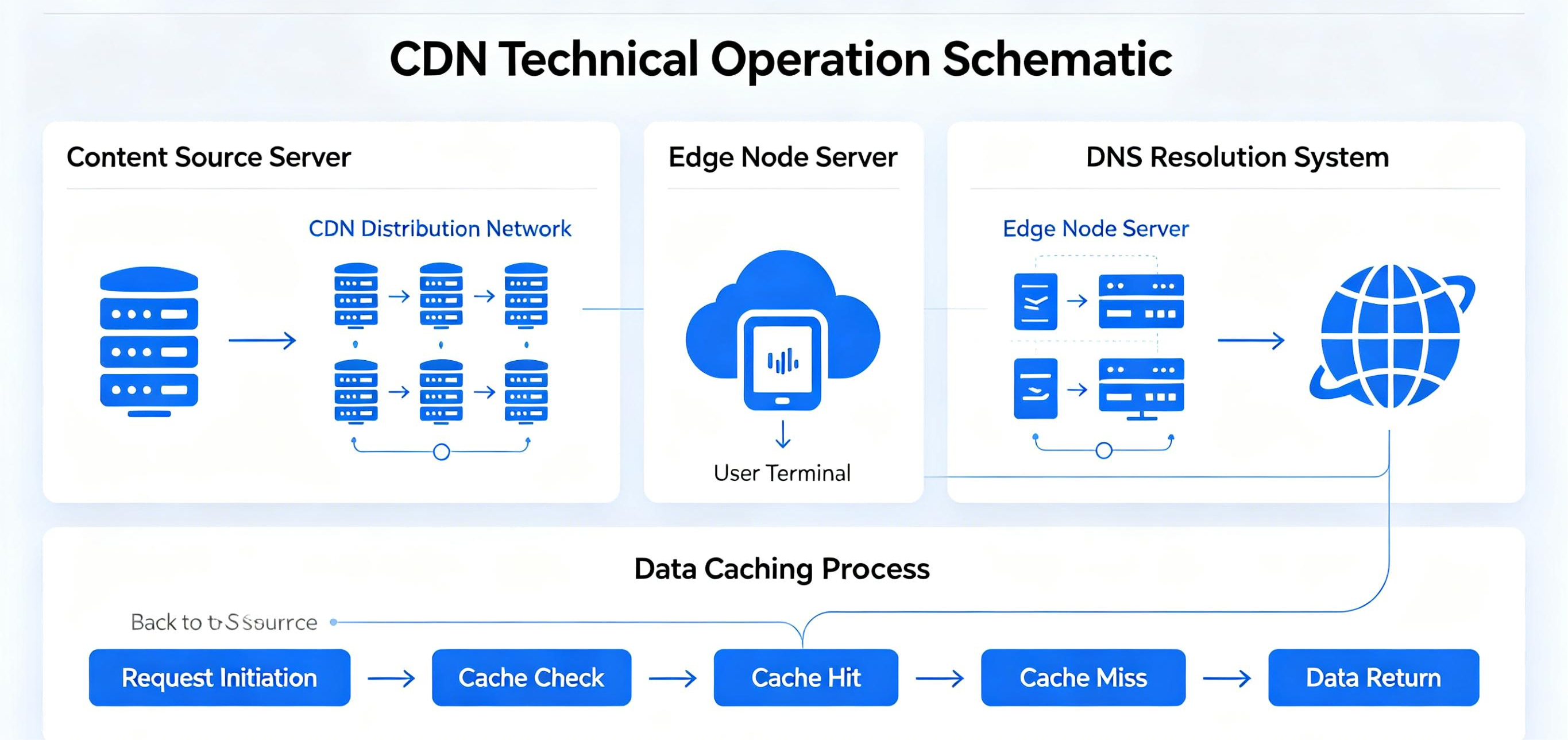
Instead, most leading high-protection CDN providers follow a distributed security architecture like this:
Global Edge Nodes
↓
Edge Threat Detection
↓
Regional Traffic Scrubbing
↓
Centralized Traffic Orchestration
This architecture allows malicious traffic to be identified and mitigated as close to its source as possible, significantly improving both mitigation speed and overall network efficiency.
How CDN07 Uses Intelligent Traffic Scrubbing to Protect Your Business
Today, more organizations are evaluating high-protection CDNs based not only on mitigation capacity, but also on the quality and intelligence of their traffic scrubbing capabilities.
Take CDN07's high-protection CDN as an example. Its security architecture combines a globally distributed edge network with an intelligent traffic scrubbing engine that continuously analyzes traffic in real time, monitors behavioral patterns, and leverages an extensive threat intelligence database to rapidly detect and mitigate DDoS attacks, CC attacks, and other malicious requests.
For online gaming platforms, cross-border eCommerce businesses, SaaS applications, and other high-traffic services, this architecture delivers strong security while minimizing the impact on legitimate users.
Because the best traffic scrubbing system isn't the one that blocks the most requests—it's the one that accurately distinguishes malicious traffic from legitimate users with the highest possible precision.
What Should Businesses Look for When Choosing a High-Protection CDN?
Don't evaluate a provider based solely on:
How many terabits (Tbps) of DDoS mitigation capacity they advertise
The total number of CDN nodes in their network
How impressive their marketing materials look
Instead, pay close attention to whether the platform offers real-time traffic analytics, advanced CC attack detection, globally distributed traffic scrubbing nodes, intelligent traffic scheduling, and technologies designed to minimize false positives.
These capabilities—not marketing numbers—are what ultimately determine how effective a high-protection CDN will be when defending your business against real-world cyberattacks.
Final Thoughts
Intelligent traffic scrubbing is far more than a marketing buzzword. It is one of the core technologies that powers every modern high-protection CDN.
From traffic collection and behavioral analysis to threat signature matching, dynamic risk scoring, global traffic orchestration, and real-time attack mitigation, every stage plays a critical role in delivering effective cybersecurity protection.
For businesses, the true value of a high-protection CDN isn't simply blocking attacks—it's ensuring that legitimate users can continue accessing websites, applications, and online services without interruption, even while an attack is in progress.
Intelligent traffic scrubbing is the technology that makes that level of resilience possible.
That's exactly why an increasing number of gaming companies, cross-border eCommerce brands, SaaS providers, and internet businesses now consider intelligent traffic scrubbing capabilities even more important than raw DDoS mitigation bandwidth when selecting a high-protection CDN provider.