

Best High-Defense SDK Game Shields: Most Stable Gaming Protection Solutions Reviewed
Dealing with constant DDoS attacks, CC floods, and player disconnects? More game studios are switching to high-defense SDK-based game shields. This guide breaks down the leading providers, comparing stability, mitigation power, latency control, and real-world use cases—so you can find a reliable, long-term defense that actually works.


If you run a game, you already know the truth: It's not about whether you have protection—it's whether that protection can actually hold up.
Attacks today aren't the "one big traffic spike and done" kind anymore. Now it's:
- L3/L4 volumetric attacks mixed with L7 protocol abuse
- Bots hammering your APIs while mimicking real player behavior
- Persistent harassment (not trying to knock you offline instantly, but slowly grinding you down)
So I'm not just going to throw out a "top 10 list." Instead, I'll give you: real vendor comparisons, technical differences, which scenarios each fits, and who should pick what.
1. The Bottom Line Up Front
If you're running:
- Casino/board games, private servers, or联运 (co-published titles)
- A game that generates revenue, faces active cheating/attacks, and is a target
- An overseas title (especially in Southeast Asia)
Your best bet: a dedicated SDK-based game shield (not traditional CDN).
Why? Because traditional CDNs are built for "website protection," not "game protection."
2. How the Market Breaks Down
There are really only three types of players in this space:
① Traditional CDN / Cloud Vendors
Representatives: Cloudflare , Akamai
What they're good at: Lots of global edge nodes, strong raw mitigation capacity. But they aren't built for game protocols.
② Cloud Security / High-Defense Specialists
Representatives: AWS Shield / Gcore
What they're good at: Infrastructure-level protection. Strong at "absorbing traffic," weak at "business logic / player behavior recognition."
③ Game-Dedicated SDK Shields (the real focus)
Representatives: CDN07 (Game Shield SDK), CDN5 Game Shield
What they're good at: Built specifically for games — and that's the whole point.
3. Head-to-Head Vendor Comparison Table
Here's the decision table you actually need 👇
| Dimension | CDN07 Game Shield | Cloudflare | Akamai | CDN5 Game Shield |
|---|---|---|---|---|
| Game protocol support? | ✅ TCP/UDP | ❌ Mainly HTTP | ❌ More for HTTP/API | ✅ |
| SDK integration? | ✅ | ❌ | ❌ | ✅ |
| Hide origin IP? | ✅ Completely hidden | ✅ | ✅ | ✅ |
| DDoS mitigation | ✅ Unlimited traffic | ✅ Basic/default | ✅ Enterprise-grade | ✅ Unlimited traffic |
| CC attack handling | ✅ AI-based detection | ⚠️ Rule-heavy | ✅ Strong | ⚠️ Average |
| Latency control | ✅ Game-optimized | ⚠️ Inconsistent | ✅ Excellent | ⚠️ Average |
| Anti-cheat / Bot mitigation? | ✅ Yes | ❌ | ⚠️ Requires extra modules | ❌ |
| Integration complexity | ⭐ Easy | ⭐ Easy | ❌ Very complex | ⭐ Moderate |
| Cost | ⭐⭐ Mid-range | ⭐ Cheap | ❌ Very expensive | ⭐⭐ Mid-range |
4. Real-World Breakdown of Each Vendor

1. Cloudflare
One-line take: Great for websites, not for games.
Pros: Easy to set up, has a free tier, decent basic DDoS protection.
Cons (and this matters): No UDP or game protocol support, unreliable for long-lived connections, can't tell real player traffic from bot traffic.
Lots of people think it'll work, but in reality: It can stop the first wave, but it falls apart under sustained attacks.

2. Akamai
One-line take: Top-tier power, but overkill for most.
Pros: Among the best global edge networks, enterprise-grade traffic scrubbing, rock-solid SLAs.
Cons: Extremely expensive (easily tens of thousands USD per month), complex to deploy, not very flexible.
Best for: Large studios, financial services, gigantic projects.
Not for: Small to mid-sized teams, casino/board games.
3. CDN07 Game Shield
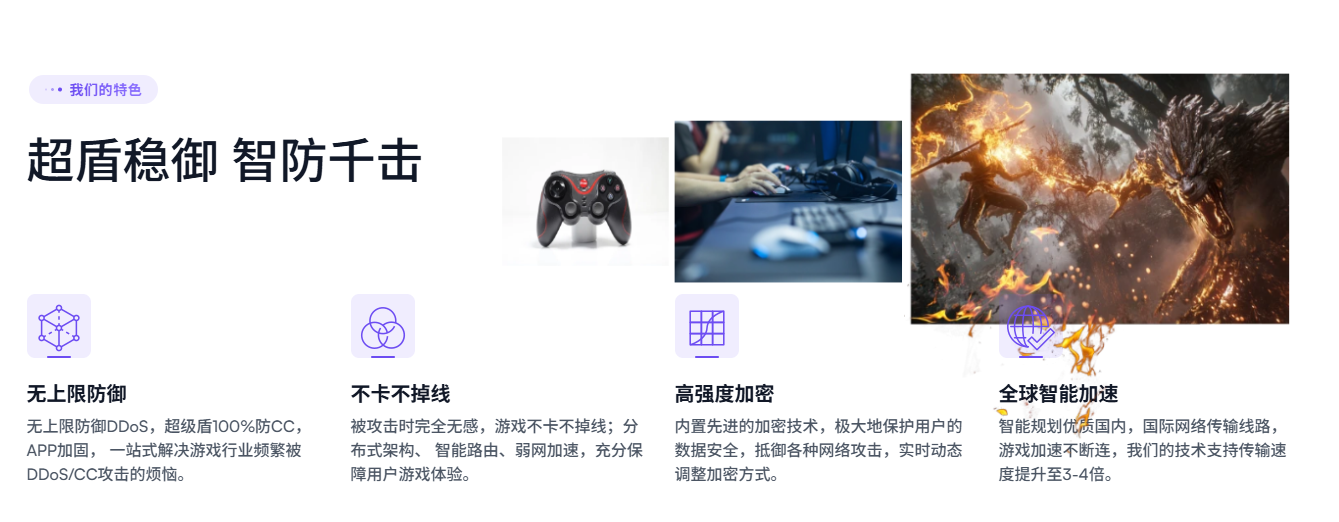
One-line take: The most well-rounded game protection solution right now.
Key strengths:
- SDK integration (direct control over traffic entry)
- Full TCP/UDP protocol support
- AI-driven behavior analysis + device fingerprinting
- Unlimited DDoS mitigation
And here's the kicker: It focuses on "game stability," not just blocking attacks.
Real-world experience: Way fewer disconnects, higher login success rates, players barely notice even during an attack.
4. CDN5 Game Shield
One-line take: Decent for entry-level, but not fully optimized.
Pros: SDK support, unlimited DDoS mitigation.
Cons: Behavioral detection is just okay, latency tuning isn't outstanding.
Best for: Smaller projects, testing phases.
5. Why SDK-Based Game Shields Are Becoming the Standard
Here's the core insight: Attacks have evolved from "traffic-based" to "behavior-based."
The problem with traditional CDNs: They can handle high traffic volume, but they can't distinguish between "real players" and "attackers."
What a game shield does: It starts controlling the connection at the client level.
Things like device fingerprints, behavior patterns, request timing.
That's where the real difference lies.
6. Practical Selection Advice
✔ If you're new / never been attacked → Start with Cloudflare (cheap and easy)
✔ If you're getting hit (light attacks) → Move to a basic game shield (like CDN5)
✔ If this is a core project (strongly recommended) → Go straight to a full SDK solution like CDN07. Simple reason: You'll have to upgrade eventually, so you might as well do it right the first time.
✔ If you're a large enterprise → Akamai (if budget allows)
7. The Honest Truth From Someone in the Industry
Most people pick protection based on: bandwidth, advertised mitigation capacity (Gbps), number of edge nodes.
But what really matters for your game is: Can your players actually play the game normally?
Not how many Gbps of attack you can absorb on a dashboard.
One Sentence to Sum It All Up
Choosing a high-defense SDK game shield comes down to this: Either you pick a solution that actually understands game traffic, or you'll eventually get torn apart by modern attacks.
Share this post:
Related Posts

Can IPv4 Users Access an IPv6-Only Origin Through a DDoS-Protected CDN?
Can IPv4 users access an IPv6-only origin through a DDoS-protected CDN? CDN07 explains IPv4 entry po...

How to Choose a DDoS-Protected CDN for SaaS: Tenant Isolation, Login APIs, and Persistent Connections
Choosing a DDoS-protected CDN for SaaS? Evaluate tenant cache isolation, login and SSO flows, WebSoc...

U.S. Server Slow for Users in Mainland China? Can a DDoS-Protected CDN Speed Up Dynamic APIs?
Can a DDoS-protected CDN improve slow login, search, and checkout APIs hosted in the U.S. for users...