

What's the Difference Between DDoS-Protected CDN and DDoS-Protected IP? A Clear Guide to Help You Choose.
What's the difference between a DDoS-protected CDN and a DDoS-protected IP? Which one should your website actually use? This article explains in plain English how they work, what they're best for, and gives real advice on choosing.

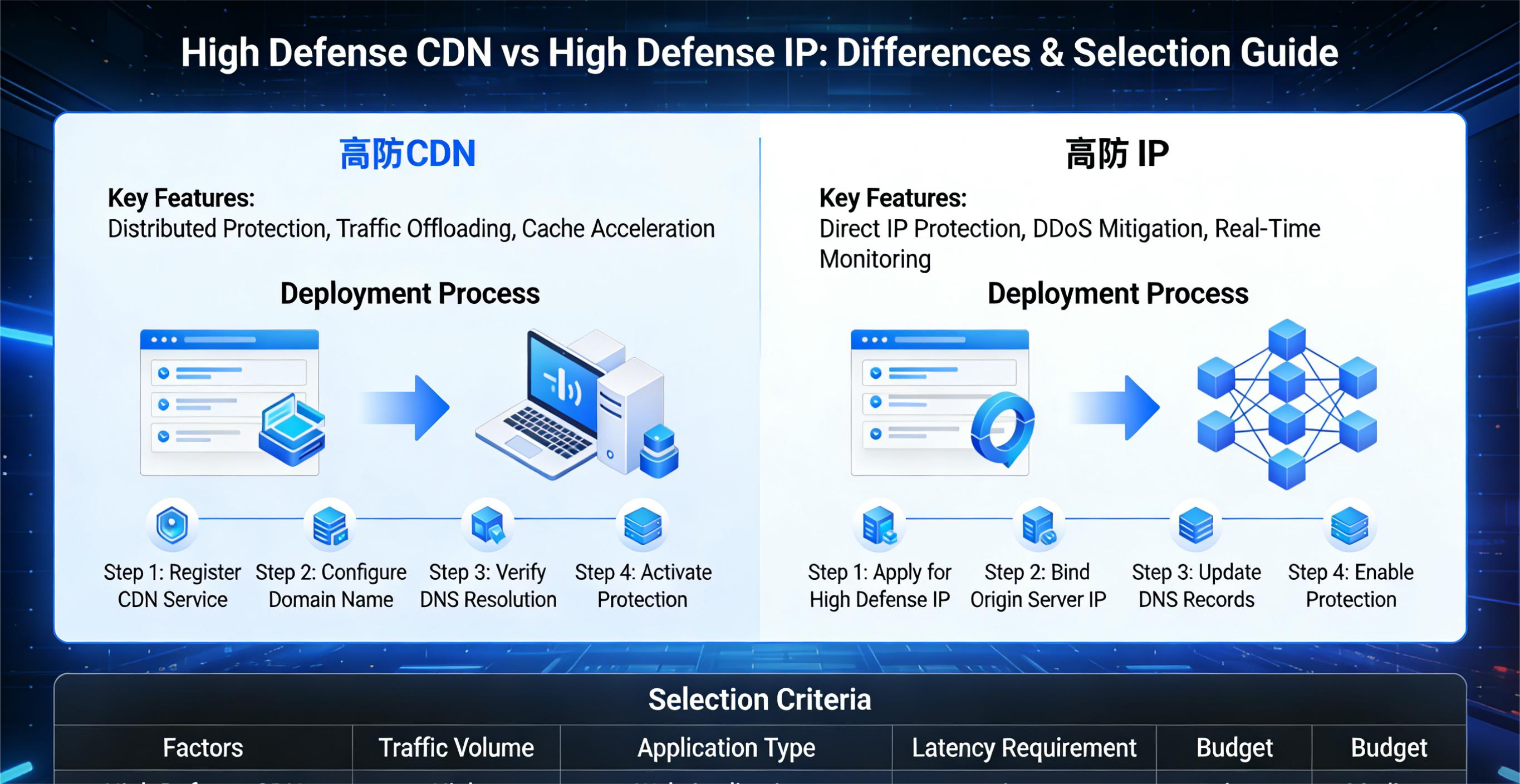
Here’s how it starts for many website owners:
- The site gets hit (DDoS attack).
- You search for "DDoS protection".
- You see two terms: DDoS-protected IP / DDoS-protected CDN.
- Every provider says theirs is the best.
- The prices are wildly different.
- You end up---picking one at random.
And then what? Money spent, attack not stopped, site still down. Or worse: the attacks get even stronger.
The problem isn't that you "chose the wrong provider." It's that---
👉 You never understood what problem each service actually solves.
Today, I'm doing one thing: explaining the core difference between these two in plain English.
一、The "Quick Answer" First
If you want the answer right now, here it is: DDoS-protected IP = A single, tough entry point. DDoS-protected CDN = Distributed protection + Speed.
To put it even simpler:
- DDoS-protected IP: 👉 Gives you one "super tough IP address." 👉 Attacks target it, and it tries to absorb the hits for you.
- DDoS-protected CDN: 👉 Gives you an entire "protective network." 👉 Attacks get spread out, intercepted, and filtered.
One is a "shield," the other is a "defense system." But hold on, the real pitfalls come next.

二、What Exactly is a DDoS-protected IP? Who is it for?
1️⃣ The Simple Explanation
Think of a DDoS-protected IP as: a "special, attack-resistant entry IP."
Your real server IP is A. The protected IP is B.
The path becomes:
User / Attacker → Protected IP (B) → Your Server (A)
All attacks hit B. If B holds up, traffic passes to A. If B fails, A goes down "innocently."
2️⃣ Key Characteristics of a DDoS-protected IP
Cutting through the marketing speak: Only one entry IP. Protection is concentrated at a single point. Usually has high bandwidth, simple setup, and looks "cheaper" upfront.
👉 Its one and only goal: "Don't let my server get hit directly."
3️⃣ Best Use Cases for a DDoS-protected IP
Let's be clear to avoid misuse.
✅ Perfect for: Game servers, API endpoints, admin/backend systems, internal systems, any service with a fixed entry point.
What these have in common: Fixed access path, no need for widespread, distributed access.
4️⃣ The Fatal Flaw of DDoS-protected IPs (Many Don't Know)
This is crucial. ❌ Single Point of Failure
No matter how much protection you buy: it's still just one point.
An attacker just needs to:
- Target that single IP.
- Keep increasing the attack volume.
- Hit it precisely.
Once it exceeds the threshold: 👉 Directly blackholed, your service goes down with it.
❌ Does NOT handle "user experience"
A DDoS-protected IP's job is: to withstand attacks.
It is NOT responsible for: speed, geographic proximity for users, user experience.
If your site is slow, it doesn't care.
三、What Exactly is a DDoS-protected CDN? What Does It Protect Against?
1️⃣ Again, the Simple Version
Think of a DDoS-protected CDN as: laying a "distributed buffer + protective network" in front of your website.
Users don't access your server directly. They access the nearest CDN node. Same for attackers.
2️⃣ The Protection Logic is Completely Different from a DDoS-protected IP
This is what many miss.
DDoS-protected IP: 👉 "Brute force absorption."
DDoS-protected CDN: 👉 "Disperse + Drain + Clean."
What does that mean?
- Attacks are spread across many nodes.
- Each node only handles a portion.
- Bad traffic is dropped at the edge.
- Only "clean traffic" reaches your origin server.
It's not about who can take more punches; it's about making the punches miss the vital spots.
3️⃣ Core Advantages of a DDoS-protected CDN
Listing only what you actually benefit from.
✅ Distributed protection. Attacks are "spread thin," harder to overwhelm, source server is well hidden.
✅ Solves "Slow + Under Attack" simultaneously.
This is one of its biggest values:
- Real users → Get faster loading.
- Attack traffic → Gets blocked.
👉 One solution, two jobs done.
✅ More flexible architecture.
- Can switch nodes.
- Can switch network routes.
- Can adjust security policies.
You have options when attacks escalate.

四、The Real Difference Isn't the "Name," It's the "Use Case"
Here's a website owner's comparison table:
| What to Compare | DDoS-protected IP | DDoS-protected CDN |
|---|---|---|
| Protection Method | Single-point absorption | Distributed protection |
| Includes Speed? | ❌ | ✅ |
| Hides Origin Server? | Somewhat | Very Well |
| Handles Sustained Large Attacks | High Risk | More Stable |
| Architecture Complexity | Low | Medium |
| Best For | Services / APIs | Websites / Platforms |
五、Why Do Many Websites "Still Die" After Choosing a DDoS-protected IP?
This is the most common scenario I deal with.
1️⃣ Websites Are Inherently "Multi-point Access"
Website traffic is:
- Users are spread out geographically.
- Many pages/assets.
- Complex requests.
Using one DDoS-protected IP for this: 👉 Doesn't make sense from the start.
2️⃣ Attackers Can Easily "Lock On"
- The IP is fixed.
- The path is clear.
This actually lowers the attacker's cost.
3️⃣ No Speed Boost, Real Users Suffer First
Often, the attack doesn't kill you; your real users leave because the site is too slow.
六、So, How Do You Choose?
You can match your situation directly.
👉 Choose a DDoS-protected IP if you have:
- Game servers
- API services
- Backend/Admin systems
- Fixed ports, fixed entry points
In a sentence: Fixed business entry point, not meant for "general public browsing."
👉 Choose a DDoS-protected CDN if you have: Websites, Platforms, SaaS, Content-based businesses.
Where visitor experience matters.
In a sentence: Many users, traffic spread out, afraid of both attacks AND slowness.
👉 Needing Both (It's Common)
Truth time: Seriously targeted projects often end up with a combined setup.
For example:
- Frontend (Website): DDoS-protected CDN
- Backend APIs: DDoS-protected IP
- Origin server completely hidden
This is the "battle-hardened" configuration.
七、Examples of Common Service Types
Cloudflare (CDN-focused)
Website: https://www.cloudflare.com
- More like a DDoS-protected CDN.
- Great for small/medium sites.
Akamai (High-end CDN)
Website: https://www.akamai.com
- CDN + Security integrated.
- Higher price point.
Various DDoS-protected IP Providers
Features are similar: Provide IP, provide protection cap, no speed optimization.
Key Takeaway
Protection isn't about buying the most expensive option, but using the right tool for the job.
DDoS-protected IPs and DDoS-protected CDNs aren't about one being better than the other. It boils down to one question:
Are you protecting "an entry point," or are you protecting "a website."

Frequently Asked Questions (FAQ)
1️⃣ Can I use a DDoS-protected CDN and a DDoS-protected IP together? Is it necessary?
Yes, and in many real-world scenarios, this is the "final form."
A common combo is:
- Frontend website traffic → DDoS-protected CDN
- Backend APIs / Core services → DDoS-protected IP
- Origin server completely hidden, only allows traffic from CDN / Protected IP
Why do this?
- CDN handles large traffic, disperses attacks, ensures good user experience.
- DDoS-protected IP guards core interfaces: logins, payments, critical APIs.
👉 This is the natural evolution for many sites that get hit hard enough.
2️⃣ What's the risk of using only a DDoS-protected IP for a website?
Straight talk: For website-based businesses, using only a DDoS-protected IP is high risk.
Three main problems:
- Single point of protection, easy to target.
- No speed optimization, real user experience suffers.
- If attacks ramp up, it's easy to exceed the threshold and get blackholed.
This is how many sites fail: The protected IP holds, but users are driven away by slow performance.
3️⃣ How much attack can a DDoS-protected CDN usually handle?
Truthfully: There's no fixed answer.
Whether it holds depends on:
- The protection tier you purchase.
- The scale of the CDN's node network.
- The attack type (flood vs. targeted).
- If the attack volume keeps increasing.
In reality:
- Tens of Gbps attacks: Most decent DDoS-protected CDNs can handle.
- Hundreds of Gbps sustained attacks: Require high-end solutions.
- Mixed attack types: Configuration and strategy matter more than just the "protection number."
👉 "Protection value" is a reference, not a magic shield.
4️⃣ If a DDoS-protected IP is labeled "100G protection," does it guarantee blocking 100G?
No, this is a common misunderstanding.
Many think: "Label says 100G = I'm safe from 100G attacks."
In reality:
- Some are "shared protection."
- Some are "peak theoretical value."
- Some simply blackhole you if you exceed it.
You should ask:
- What happens if we exceed it?
- Is there auto-scaling?
- Is it dedicated/private?
5️⃣ Does a DDoS-protected CDN hurt SEO?
Normally, no. It often helps.
Simple reasons:
- Website is more stable.
- Fewer 5xx server errors.
- Faster load times.
- Better availability.
For search engines: "Stable + Accessible" is always a plus.
⚠️ But only if:
- CDN is configured correctly.
- You don't frequently change domains.
- No messy redirects.
6️⃣ If I use a DDoS-protected CDN, do I still need to worry about server security?
Yes, absolutely.
A DDoS-protected CDN defends against:
- Volumetric (flood) attacks.
- Application-layer (request) attacks.
It does NOT protect against:
- Server software vulnerabilities.
- Application backdoors.
- Weak passwords.
- Internal permission issues.
👉 The CDN is the "outer wall." Server security is the "inner door."
7️⃣ Can a DDoS-protected CDN stop CC attacks?
It can mitigate them, but it's not a silver bullet.
CC attacks are tricky because they:
- Mimic real user visits.
- Send requests that look "human."
- Target high-resource endpoints.
A good DDoS-protected CDN uses:
- Rate limiting.
- Behavioral analysis.
- JS challenges.
- Bot/CAPTCHA challenges.
But if:
- Your endpoint itself is poorly designed.
- A single request consumes huge resources.
👉 Even the best CDN will struggle.
8️⃣ Can a regular CDN + WAF replace a DDoS-protected CDN?
For mild scenarios, yes. For serious attacks, no.
Works for:
- Low traffic sites.
- Infrequent, minor attacks.
- General scanning/probing.
Not enough for:
- Sustained DDoS floods.
- When you're clearly being targeted.
- Large volumetric attacks.
In a nutshell: Regular CDN+WAF is for "stopping thieves." DDoS-protected CDN is for "stopping rioters."
9️⃣ Why is a DDoS-protected CDN so much more expensive than a regular CDN?
Three core reasons:
- Massive bandwidth costs (to absorb attacks).
- Expensive traffic scrubbing/filtering hardware.
- More hands-on human expertise and support.
You're not just buying "traffic." You're buying: The resources, capability, and strategy to stay up when you're under fire.
🔟 Is it a waste of money for a small site to start with a DDoS-protected CDN?
In most cases, yes.
If your site:
- Has low daily traffic.
- Has no real search ranking yet.
- Isn't a target for competitors.
👉 It's smarter to spend on content, promotion, and basic architecture first.
But if you're in:
- A high-risk industry (gambling, crypto, etc.).
- A sensitive business.
- A space where attacks are likely from day one.
Then getting it early is worth every penny.
1️⃣1️⃣ Are DDoS-protected CDN and "Bulletproof/Anti-Abuse CDN" the same thing?
No. They solve completely different problems.
- DDoS-protected CDN: 👉 Protects against attacks (DDoS / CC).
- Bulletproof/Anti-Abuse CDN: 👉 Protects against malicious DMCA/abuse complaints, keeps hosting online despite reports.
Some businesses need both, but know the goal of each.
1️⃣2️⃣ Can a DDoS-protected CDN accidentally block real users?
Yes, but good providers minimize this risk.
This is the core tension of security: Block more aggressively, higher chance of false positives. Be more permissive, higher risk of letting attacks through.
That's why:
- Security rules need tuning.
- It's not a "set it and forget it" service.
Share this post:
Related Posts

How to Choose a DDoS-Protected CDN for Mainland China: Speed and Security Guide
How can websites hosted overseas improve access from Mainland China without compromising DDoS protec...

What to Do When Your Website Is Slow: A Practical Guide to Troubleshooting DNS, TTFB, and Resource Loading
Why is your website slow to load? This guide walks through DNS resolution, connection setup, TTFB, i...

Why Online Card and Board Games Need an SDK-Based Game Shield for DDoS Protection
Online card and board games face persistent security risks, including DDoS attacks, HTTP floods, che...