

Architecture, Principles, and Selection Guide for Anti-Block CDN & Anti-Throttle CDN
How do Anti-Block CDNs and Anti-Throttle CDNs actually work? In this guide, we'll break down their architecture, explain the core principles, suitable use cases, and key selection criteria to help site owners reduce blocking risks and improve access stability.

If you've run even slightly "sensitive" online services or your site attracts a diverse audience, you've probably faced issues like:
- Your site suddenly becomes inaccessible in certain regions.
- Your domain isn't reported, yet DNS resolution acts up.
- You can ping the IP, but the browser times out.
- It works during the day, but "parts go dark" at night.
- Changing servers doesn't help, and new domains don't last long.
That's when many site owners realize:
It's not a server problem—you're being blocked or throttled.
Terms like "Anti-Block CDN" and "Anti-Throttle CDN" start popping up everywhere.
But honestly, these terms are often misused. Many people don't really understand:
- What exactly are they protecting against?
- Is the technology actually reliable?
- Is there really a "100% unblockable" solution?
- Can choosing wrong make things worse?
In this article, I'll explain everything from a real-world network perspective.
1. Let's Be Clear: What's "Blocking" vs. "Throttling"?
This is the foundation.
1️⃣ "Blocking" typically means three things:
① DNS-Level Blocking
- DNS pollution/cache poisoning.
- Returning incorrect IP addresses.
- Resolution failures in specific regions.
② IP-Level Blocking
- Target IP packets are dropped.
- TCP connections fail to establish.
- ISP-level traffic blocking.
③ SNI / HTTP-Level Blocking
- Identification during TLS handshake.
- Connection resets for specific Host headers.
- Appears as "network issues" but is targeted blocking.
Many site owners just see "site not loading," without knowing which layer is affected.
2️⃣ "Blocking" and "Throttling" are not the same.
A simple distinction:
- Blocking:
Hard denial—you simply can't connect. - Throttling:
Soft limits—interference, speed reduction, instability.
In reality, most sites aren't instantly blocked but gradually throttled:
- Packet loss starts.
- Followed by timeouts.
- Then intermittent access.
- Finally, complete unreachability.
That's why many misdiagnose it as "server instability."
2. What Are Anti-Block / Anti-Throttle CDNs Actually Protecting Against?
Here's the bottom line upfront:
Anti-Block / Anti-Throttle CDNs don't guarantee you'll "never be blocked." Their goal is to reduce the probability of being identified, targeted, and completely shut down.
Their core objectives are threefold:
- Hide the origin server.
- Disperse risk points.
- Increase the cost of blocking you.
Note: It's not about "absolute security," but making it harder for adversaries to target you.
3. The Core Architectural Logic of Anti-Block CDNs
A truly reliable Anti-Block CDN must have the following architectural features.
1️⃣ Architecture 1: Multi-Layer Relay + Origin Hiding
This is the fundamental layer.
The typical structure is:
The key points are:
- The origin server's public IP is not exposed.
- The origin rejects all non-CDN traffic.
- Relay nodes can be swapped out at any time.
If your origin IP can be directly scanned, "anti-block" is basically zero.
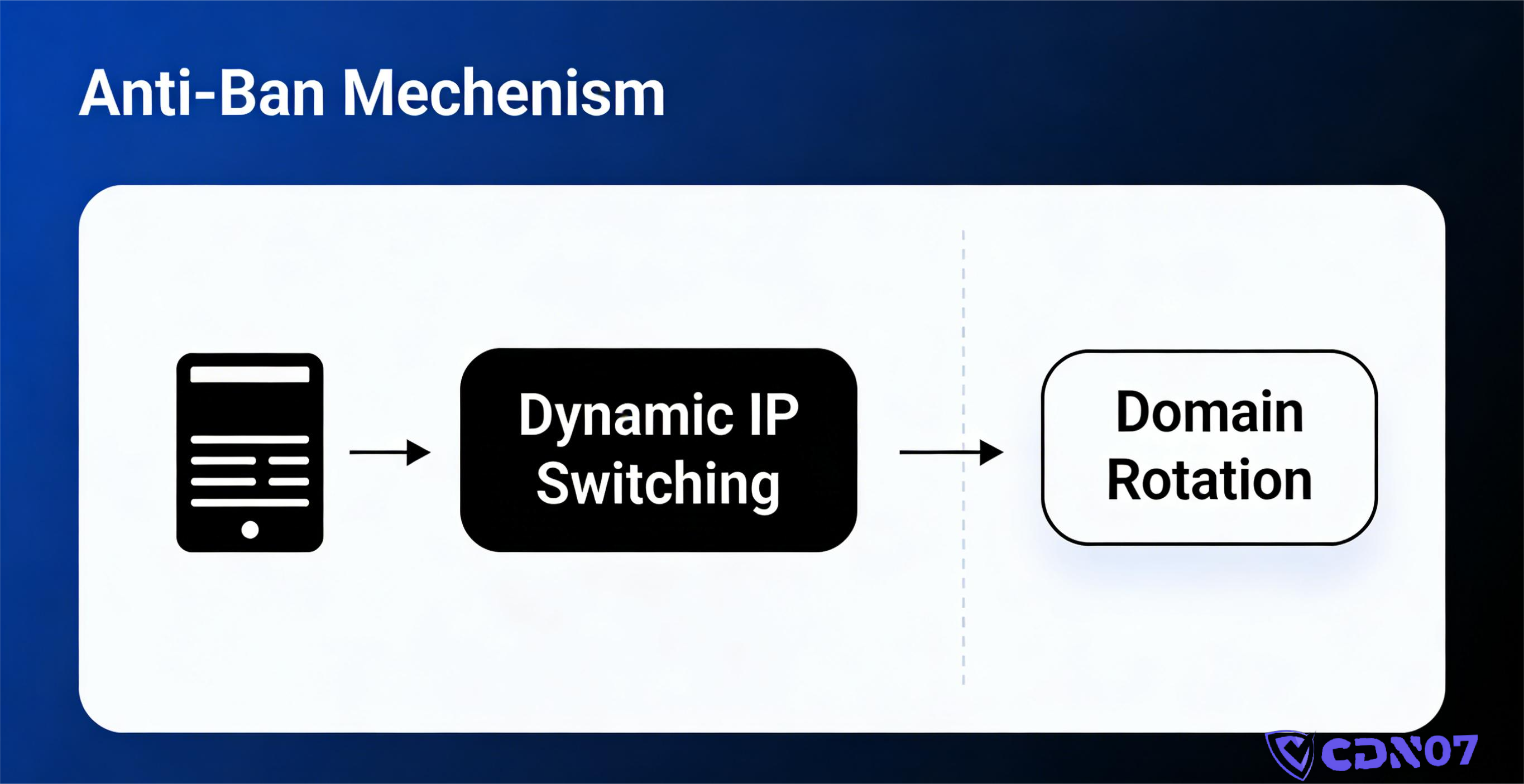
2️⃣ Architecture 2: Multi-Entry, IP Pool Rotation
This is where many "fake" anti-block CDNs fall short.
A real anti-block CDN typically has:
- A large pool of IPs
- Dynamic IP rotation
- Multiple entry points for the same domain
The logic is simple:
Blocking one IP is pointless,
Blocking a range is costly,
Blocking the entire CDN is extremely expensive.
The problem with small CDN providers:
- Few IPs.
- Fixed nodes.
- Easy to be "fingerprinted."
Once identified, the entire range can be taken down.
3️⃣ Architecture 3: Anycast / Multi-Region Routing
A lot of anti-throttle capability comes from Anycast architecture.
Anycast's core value isn't "speed," but:
- Different regions see different entry points.
- Blocking is regional, not global.
- If one region has issues, others remain unaffected.
This is crucial for "anti-throttling."
Because in reality, blocking is often a regional policy, not a global one.
4️⃣ Architecture 4: Protocol & Behavioral Obfuscation
Modern throttling isn't just about IPs. It also looks at:
- Access patterns.
- Request signatures.
- TLS fingerprints.
- HTTP header characteristics.
Advanced anti-block CDNs address this by:
- Standardizing request signatures.
- Simulating real browser behavior.
- Limiting abnormal request rates.
- Detecting suspicious patterns and adapting automatically.
This goes beyond traditional CDN capabilities—it's a hybrid of security + CDN.
4. The Focus of Anti-Throttle CDNs: Not Just "Access," but "Stable Access"
A common misconception among site owners:
If the page loads, you're not being throttled.
The reality is often:
- Page loads.
- Images fail.
- JS times out.
- APIs occasionally return 504.
- Things get painfully slow at night.
This is classic "soft throttling."
Anti-throttle CDNs tackle three main problems:
1️⃣ Avoid Predictable Paths
- Dynamic routing.
- Multi-path origin fetching.
- Automatically bypassing problematic routes.
2️⃣ Reduce Fingerprinting
- Avoid obvious "CDN-specific" headers.
- Minimize consistent fingerprints.
- Avoid uniform request patterns across the site.
3️⃣ Decentralize Access Anomalies
- Rate limiting.
- Request dispersion.
- Simulating real-user distribution.
In a nutshell:
It's not about fighting blocking head-on, but about not looking like a target.
5. Anti-Block CDN ≠ Magic Bullet – Situations It Can't Fix
Let's be honest.
In these scenarios, no CDN can save you:
❌ Content is highly sensitive/illegal.
❌ Already on a definitive blacklist.
❌ All traffic depends on a single domain.
❌ Heavy reliance on fixed IPs / ports.
❌ Your own code behaves abnormally (clear bot-like patterns).
Anti-block CDN is a "technical buffer," not a "get-out-of-jail-free card."
6. Anti-Block CDN vs. Regular CDN: What's the Real Difference?
| Aspect | Regular CDN | Anti-Block / Anti-Throttle CDN |
|---|---|---|
| IP Pool Size | Small | Large IP Pool |
| Architecture | Single Layer | Multi-Layer Relay |
| Origin Exposure | Likely | Strongly Hidden |
| Routing Capability | Basic | Intelligent / Regional |
| Behavioral Obfuscation | None | Yes |
| Anti-Block Strength | Low | Medium to High |
| Cost | Low | Medium to High |
So you'll notice:
"Anti-block CDNs are cheap" – that's rarely true.
7. What Types of Sites Actually Need Anti-Block / Anti-Throttle CDNs?
Realistic use cases:
✔ Cross-border operations with complex audiences.
✔ Frequent "unavailable in some regions" issues.
✔ High cost of changing domains.
✔ Cannot afford frequent downtime.
✔ High business continuity requirements.
Clear mismatches:
✘ Standard corporate websites.
✘ Fully compliant, stable content.
✘ Very low traffic.
✘ Extremely cost-sensitive.
8. 7 Must-Ask Questions When Choosing an Anti-Block CDN (Avoid Scams)
This is the most practical part for site owners.
Asking these 7 questions will help you avoid 80% of pitfalls:
- Is the origin server completely unreachable directly? How is this verified?
- How large is the IP pool? Is it dynamically rotated?
- Does it support Anycast or multi-region entry points?
- Does it auto-switch if a node is blocked? How fast?
- Is there a relay layer, not just a single proxy layer?
- Does it provide real abnormal traffic monitoring?
- What's the actual emergency plan if blocking occurs?
If the answers are vague or they just say "we're stable," it's probably best to walk away.
9. A Realistic Conclusion
Here's an honest, perhaps unpopular, conclusion:
Anti-block CDNs can delay risks, reduce losses, and improve stability, but they cannot change the inherent risk profile of your business.
The real long-term stability strategy is always:
- Distributed architecture.
- Risk segmentation.
- Multiple entry points.
- Not putting all your eggs in one (domain) basket.
Not relying on a single "magic CDN."
Final Thought: Anti-Blocking is a Strategy, Not a Product
If you remember one thing:
The essence of Anti-Block / Anti-Throttle CDNs is to use architectural design and intelligent routing to break down the risk of a "total shutdown" into "localized, recoverable, switchable" problems.
They solve for "resilience," not "permanent safety."
If your site is already experiencing:
- Regional outages.
- Unexplained access failures.
- Server changes that don't help.
Then the question isn't "should I change servers?"
It's whether you need to upgrade your entire access architecture.
FAQ:
Q1: What is an Anti-Block CDN?
A: An Anti-Block CDN is a content delivery architecture designed to lower the probability of domain or IP blocking through multi-node routing, IP pool rotation, and origin hiding. It does not guarantee permanent unblockability.
Q2: What's the difference between an Anti-Block CDN and a regular CDN?
A: Regular CDNs focus on accelerating content delivery. Anti-Block CDNs prioritize origin concealment, IP rotation, node switching, and regional routing to reduce the risk of identification and blocking.
Q3: Can an Anti-Throttle CDN completely prevent access issues?
A: No, but it can significantly reduce regional packet loss, timeouts, and unstable access, turning potential total failures into localized, manageable issues.
Q4: Are Anti-Block CDNs suitable for all websites?
A: No. They are best for cross-border sites, services with complex regional audiences, or those already experiencing regional blocking. They offer little benefit for standard, compliant corporate sites.
Q5: Is an Anti-Block CDN the same as an "Anti-Censorship CDN"?
A: No. Anti-Block CDNs aim to improve stability and architectural resilience, not to circumvent clear policy-based censorship. Their technical goals and use cases differ.
Q6: Does using an Anti-Block CDN affect site speed?
A: A well-designed Anti-Block CDN should not noticeably reduce speed and may improve it via nearby nodes. Poorly designed architectures can add latency.
Q7: Does Anycast help with Anti-Throttling?
A: Yes. Anycast disperses traffic and risk across multiple regions, preventing single-point failure, making it a common anti-throttling technology.
Q8: How to evaluate if an Anti-Block CDN is reliable?
A: Check for true origin hiding, a sufficiently large and rotating IP pool, automatic node failover, and real-time traffic monitoring with actionable response plans.
Q9: What are the main cost drivers for Anti-Block CDNs?
A: Costs come from the number of nodes, bandwidth, IP resources, and sophisticated routing systems. This is why genuine Anti-Block CDNs are rarely cheap.
Q10: Is an Anti-Block CDN a long-term solution?
A: It's part of a risk management strategy, not a final solution. Long-term stability requires sound business architecture, content compliance, and multi-entry design.
Share this post:
Related Posts

How to Choose a DDoS-Protected CDN for Mainland China: Speed and Security Guide
How can websites hosted overseas improve access from Mainland China without compromising DDoS protec...

What to Do When Your Website Is Slow: A Practical Guide to Troubleshooting DNS, TTFB, and Resource Loading
Why is your website slow to load? This guide walks through DNS resolution, connection setup, TTFB, i...

Why Online Card and Board Games Need an SDK-Based Game Shield for DDoS Protection
Online card and board games face persistent security risks, including DDoS attacks, HTTP floods, che...