

Who is Akamai China CDN partner?And What Should You Choose After Its Exit
Akamai is exiting the China CDN market in 2026. Who is their local partner? This article details Akamai’s operational model in China, the reasons behind their withdrawal, and compares next-generation China CDN solutions to help businesses select the most stable acceleration service for China.

If you’ve been following the China CDN market recently, you’ve likely encountered a critical piece of news: Akamai will officially cease its China CDN services on June 30, 2026.
This isn’t a minor adjustment—it’s a strong signal that the model international CDNs have relied on in China is no longer viable.
This change has led many businesses to revisit a fundamental question:
👉 Who is Akamai’s China CDN partner?
👉 How did they operate in China previously?
👉 Now that they’re exiting, who should you switch to?
In this piece, we’ll go beyond a simple answer and break down the entire situation.
1. Who is Akamai’s China CDN partner?
The surface-level answer is straightforward: Akamai’s core partner in China is Wangsu Science & Technology (ChinaNetCenter).
But stopping there means missing the bigger picture.
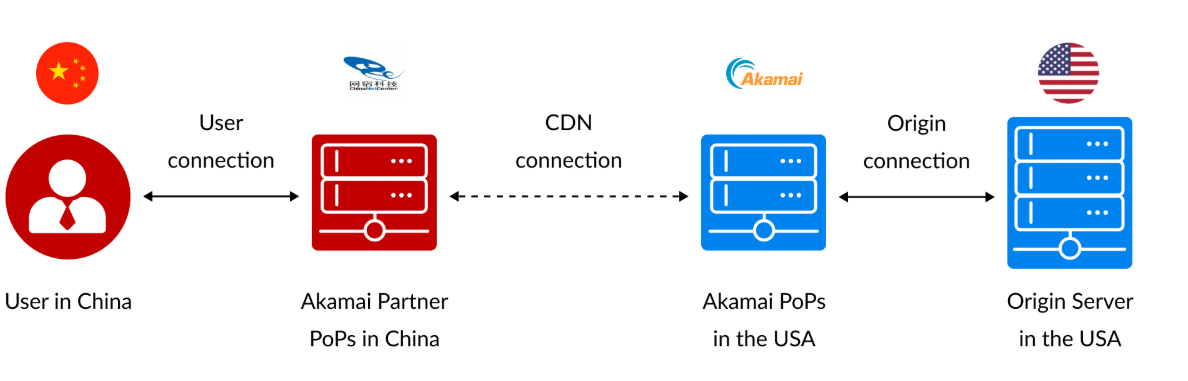
The actual architecture looks like this:
- Akamai: handles global traffic management and platform capabilities.
- Local Chinese partner: manages nodes and content distribution within mainland China.
- Enterprise customers: access the Chinese network via Akamai.
Essentially, it’s an “international CDN shell” with a “local Chinese CDN core”.
This also explains why many users feel a disconnect: you pay for Akamai, but the experience often feels like a patchwork of local CDN services.
2. Why is Akamai ultimately exiting China?
Many assume this is just a “business adjustment,” but the deeper reasons come down to three factors:
1️⃣ Rising Compliance Costs
Operating a CDN in China isn’t just a technical challenge; it involves:
- ICP licensing
- Data localization requirements
- Network access permits
For international providers, this translates to high operational costs and low flexibility over the long term.
2️⃣ An Architecture Ill-Suited for China’s Network
China’s internet isn’t simply a part of the global web; it’s a relatively independent network ecosystem.
Key challenges include:
- Fragmentation between the three major carriers (China Telecom / China Unicom / China Mobile)
- Unstable cross-carrier connections
- DNS poisoning and network interference
- Uncertain accessibility due to the Great Firewall (GFW)
This means global traffic management logic often breaks down within China.
3️⃣ Evolving User Demands
Previously, businesses were satisfied with just: ✔ Accessibility ✔ Decent speed.
Now, the requirements are: ✔ Stability ✔ Low latency ✔ DDoS protection ✔ Blocking prevention ✔ Long-term cross-border reliability.
However, Akamai’s China model typically fails to address:
❌ Anti-blocking
❌ Resource loading issues (e.g., third-party scripts)
❌ High-level DDoS protection
3. An Overlooked Reality: Akamai China CDN Was Never a Complete Solution
This point, often subtly hinted at, is critical: CDN ≠ China Access Solution.
Consider a real-world scenario: An international website fails to load in China. The root cause could be:
- Failed loading of Google Fonts
- Blocked JS resources
- API request timeouts
- DNS pollution
A CDN can only address part of this: ✔ Static resource acceleration.
But it cannot solve:
❌ Unavailable resources
❌ Network policy restrictions
❌ Firewall interference
Thus, many businesses found that even with Akamai China CDN, the core problems persisted.
4. Three Real Challenges Businesses Face After Akamai’s Exit
Post-2026, these issues will become more pronounced:
1. Loss of China Accessibility
It won’t just slow down; it could become completely inaccessible.
2. Inability to Migrate Existing Architectures
Your previous setup depended on: Akamai + their local partner.
Now, that chain is broken.
3. Increased Risk of Attacks
Many businesses overlooked a key fact: Traffic targeting China faces a high risk of cyberattacks.
Without robust DDoS protection, attacks like DDoS and CC can easily cripple your services.
5. How Mainstream Solutions Have Evolved
This is the most crucial part of our discussion.
Moving from “CDN Tool” to “China Network Solution”
Effective solutions today must simultaneously address:
✔ Accessibility
✔ Speed
✔ Stability
✔ Attack Protection
✔ Blocking Prevention
This shift explains why more businesses are turning to China-Optimized High-Defense CDN solutions (often referred to as China CDN App architecture).
6. Why Solutions Like CDN07 Are Becoming Mainstream
Let’s focus on the capabilities rather than just claims.
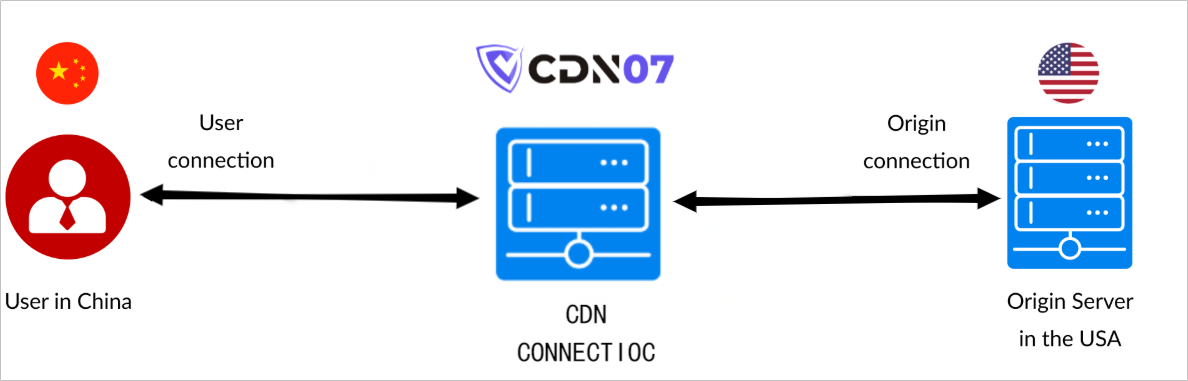
CDN07 isn’t a traditional CDN provider; it’s a prime example of an integrated service provider specializing in "Cross-Border Connectivity + High-Defense Protection + China Optimization".
Background & Technical Expertise
- Founded in 2014 (Australia)
- Developed proprietary BGP intelligent defense system in 2017 (a core capability)
- Completed deployment of 30+ global nodes by 2020
- Serves 5,000+ enterprises
- Has mitigated over 100,000 DDoS attacks
👉 What does this mean? It’s not just about selling bandwidth; it’s about being a company with long-term expertise in attack mitigation and network optimization.
✔ Core Capabilities for the China Market
1️⃣ Dedicated China Network Paths (Not Standard Lines)
- Direct connection to mainland China
- Low latency
- Significantly higher stability compared to public cross-border routes
2️⃣ Anti-Blocking / GFW Mitigation Capabilities
- Navigates firewall restrictions
- Resists IP blocking
- Adapts to mobile carrier-specific limitations
This is an area traditional CDNs typically don’t address.
3️⃣ No Restrictive Business Type Limitations
Many providers impose restrictions on:
- Gaming
- High-bandwidth applications
- Certain business verticals
CDN07 generally operates without such rigid restrictions, making it more adaptable for complex cross-border businesses.
4️⃣ High-Defense Capabilities (Core Strength)
- DDoS Protection
- CC Attack Mitigation
- Intelligent attack traffic identification
This isn’t an add-on feature; it’s a foundational element of the platform.
5️⃣ USDT Payment Support
This is a significant advantage for many cross-border clients:
- Greater flexibility
- Enhanced privacy
- Avoids currency exchange complexities
7. Akamai vs. Next-Generation China CDN Solutions
| Aspect | Akamai China Solution | Next-Gen China CDN (e.g., CDN07) |
|---|---|---|
| Architecture | Partner-based integration | Unified, integrated platform |
| Service Continuity | ❌ Ends in 2026 | ✔ Ongoing service |
| ICP License Required | ✔ Yes | ❌ Not required |
| China Access Stability | Moderate | High |
| Attack Protection | Limited (often relies on add-ons) | Strong (built-in) |
| Anti-Blocking Capability | ❌ No | ✔ Yes |
| Suitability for Cross-Border | ❌ Moderate | ✔ Highly Suitable |
8. The Real Conclusion
If your question is simply: Who is Akamai’s China CDN partner?
The answer is: Wangsu Science & Technology (ChinaNetCenter).
But if you’re asking the more practical question: Which CDN should you choose after Akamai’s exit?
The answer comes down to this: Choose a solution that "works stably and reliably in China over the long haul," not one that is merely "theoretically available."
👉 Accessing the Chinese network has never been as simple as just “plugging in a CDN.”
It’s better understood as: an independent network ecosystem, combined with its own compliance framework and threat environment.
Akamai’s withdrawal simply brings this reality into sharper focus.
Frequently Asked Questions (FAQ)
1️⃣ Who is Akamai’s China CDN partner?
Akamai’s core partner in China is Wangsu Science & Technology (ChinaNetCenter), which provides the nodes and content delivery capabilities within mainland China.
It’s important to note this is a “cooperative model,” not a self-built network by Akamai.
Meaning:
- Akamai handles the global traffic management.
- Local Chinese partners actually operate the nodes within China.
👉 It’s essentially an “indirect service,” not a native China CDN.
2️⃣ Why is Akamai exiting the China CDN market in 2026?
Akamai has confirmed it will discontinue its China CDN services on June 30, 2026. Key reasons include:
- Excessive compliance costs (ICP licenses, data localization)
- Network architecture not well-suited for the Chinese environment
- Performance and control limitations inherent in the partnership model
Simply put: High investment, numerous restrictions, and unstable performance made it unsustainable.
3️⃣ How will Akamai’s exit impact access from China?
The impact will be direct and noticeable:
- Reduced access speeds for users in China
- Potential inaccessibility in certain regions
- Increased failure rates for cross-border requests
Without a replacement: It won’t just get slower; it may become entirely inaccessible.
4️⃣ Can I use a China CDN without an ICP license?
Traditionally, the answer was no.
However, newer solutions exist:
China-Optimized CDN (China CDN App architecture)
Services like CDN07 offer:
- No ICP license required
- Access to China via dedicated network paths and optimized routes
- Access experience comparable to local CDN services
👉 For cross-border businesses, this is currently the most practical approach.
5️⃣ Why do many CDNs seem usable in China but perform poorly in reality?
Many so-called “China acceleration” solutions rely on: A Hong Kong node + standard public cross-border routes.
The problems with this approach:
- High latency (100ms to 300ms+)
- Significant packet loss
- Instability during peak hours
Effective solutions require:
- Dedicated access lines into China
- Multi-carrier (BGP) traffic management
- Local network optimization
6️⃣ What’s the difference between a China CDN App and a traditional CDN?
These concepts are often confused. Here’s a simple breakdown:
| Type | Core Function |
|---|---|
| Traditional CDN | Static content distribution |
| China CDN App | Comprehensive optimization for the Chinese network |
A China CDN App typically includes:
- Dynamic content acceleration
- API call optimization
- Intelligent traffic routing
- Built-in attack protection
It functions more as a holistic “network solution” than a single-purpose tool.
7️⃣ How can I tell if a CDN is genuinely suitable for the Chinese market?
Use these criteria for a quick assessment:
✔ Does it offer dedicated access lines into China?
✔ Is it usable without an ICP license?
✔ Does it provide cross-border optimization?
✔ Does it include robust DDoS/CC protection?
✔ Is it consistently stable (not just occasionally fast)?
Meeting 3 or more criteria indicates it’s “usable.”
Meeting all of them suggests it’s viable for “long-term, reliable operation.”
8️⃣ Which CDN solution is the most reliable choice for businesses now?
For cross-border operations (apps, e-commerce, platforms), it’s advisable to prioritize:
China-Optimized High-Defense CDN solutions, such as CDN07, which typically offer:
- Direct usability without ICP registration
- Dedicated lines for accessing China
- Integrated high-defense protection
- Support for complex business scenarios
- Flexible payment options, including USDT
The core advantage is: Enabling stable, long-term operations, not just providing temporary “access.”
A Final Note
If you’re currently using Akamai or planning to enter the China market:
The sooner you start testing alternatives, the smoother your transition will be.
Waiting until the service is officially discontinued often results in being forced into a difficult, last-minute migration.
Share this post:
Related Posts
Which Websites Are a Good Fit for CDN07's DDoS-Protected CDN, and How Does It Compare with Cloudflare?
Compare CDN07 and Cloudflare for websites serving users in Mainland China, including connectivity, D...

How Much Does a DDoS-Protected CDN Cost per Month? Plans, Legitimate Traffic, and Additional Charges
The monthly cost of a DDoS-protected CDN depends on the plan allowance, legitimate traffic usage, pr...

How to Choose a DDoS-Protected CDN: Workloads, Network Connectivity, and Protection
Choosing a DDoS-protected CDN takes more than comparing mitigation capacity and monthly price. This...