

Who Is the Largest CDN Provider? Understanding Real Influence Through Global Traffic Share
The global CDN market is fiercely competitive, but "largest" isn't about fame—it's about actual traffic share. We break down node scale, bandwidth capacity, DDoS mitigation, and global coverage in plain terms to show you who the real top CDN providers are.

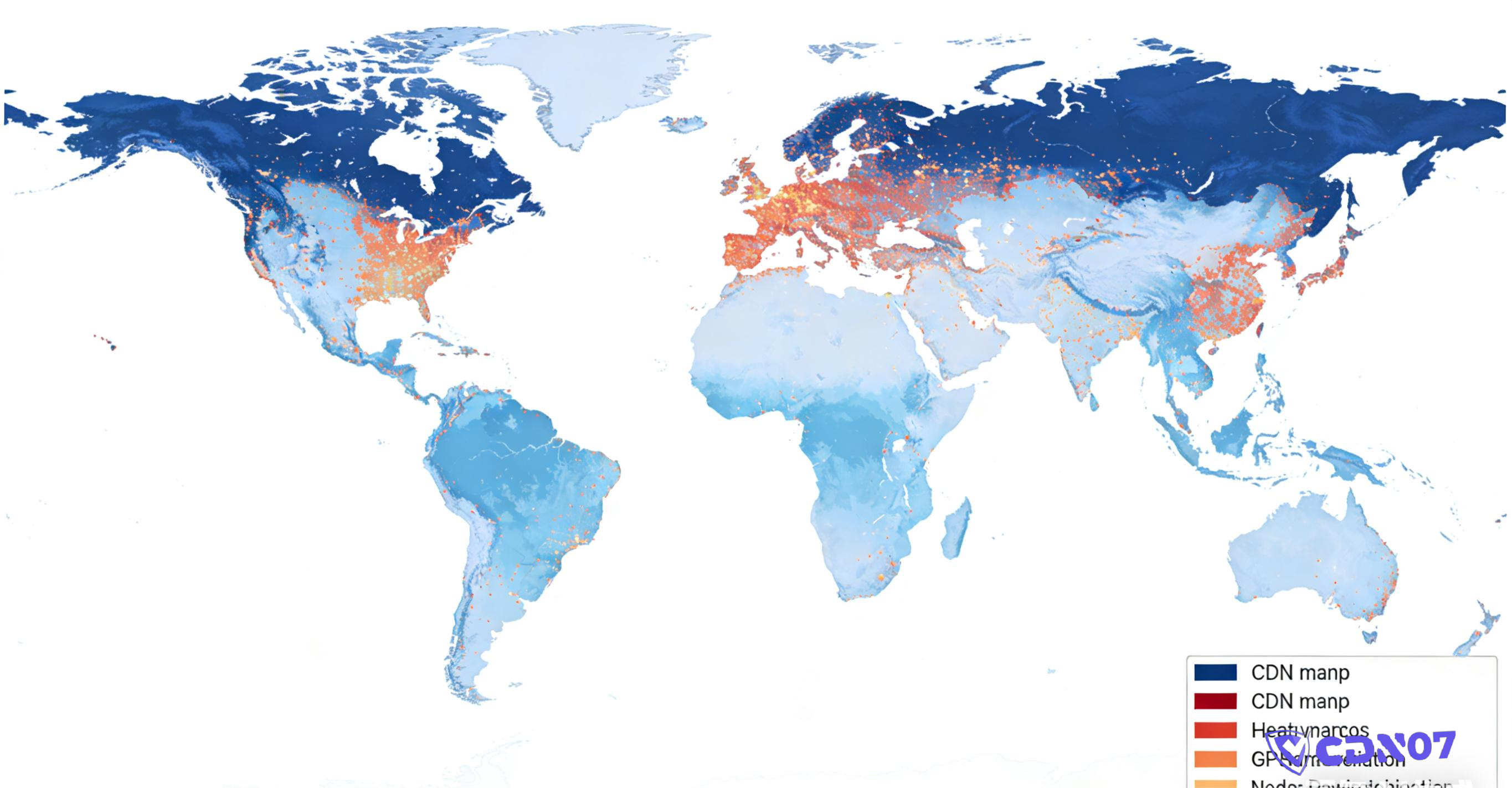
The internet isn't a single road; it's a vast network of highways with countless interchanges. Whoever can deliver content to users the fastest wins a larger piece of the pie.
But that leads to some big questions:
"Who is the largest CDN provider?"
"Why do some lesser-known providers handle more traffic than you'd think?"
"Does more nodes equal bigger? And what does bandwidth capacity really mean?"
As a network engineer with over a decade in the industry, I've watched CDN evolve from a "website accelerator" into "global infrastructure."
I've also seen CDNs with moderate public profiles handle massive traffic shares because they power major platforms and tech giants.
In this article, we're cutting through the hype. No rankings based on "market cap" or "marketing claims."
We're using one core metric:
➡ Global Traffic Share (Real Traffic Share)
Who actually carries the weight of the global internet's traffic? That's who is truly the "largest" CDN.
一、The Three Key Metrics for Gauging CDN Size
1) Global Bandwidth Capacity (Global Egress Capacity)
A CDN's core function is being a "traffic hub," not a game of node count.
True scale is shown in available bandwidth—how much egress traffic it can handle simultaneously.
Some CDNs have nodes everywhere, but each might only offer tens of Gbps, limiting their surge capacity.
Providers like Akamai and Cloudflare, however, have individual points of presence (PoPs) with multi-Terabit capacity.
Greater bandwidth capacity means not just scale, but also stronger DDoS attack resilience.
2) Real Customer Traffic (Traffic Served)
This metric is more telling than "number of customers."
For example:
- You could have 100,000 small websites and still not match the traffic of a single client like TikTok.
- You might have few SMB clients, but if you serve Netflix, Disney+, or the App Store, you're a global top player.
The industry knows this well: Enterprise clients drive traffic volume; SMBs add to the count.
3) Global Coverage Quality (PoP Quality)
It's not about more nodes, but better nodes.
This includes:
- Single-PoP bandwidth
- Fiber network connectivity
- Peering relationships with ISPs
- Proximity to internet backbones
- Real-world routing optimization capabilities
High-quality PoPs mean a CDN can truly "control the route," instead of being at the mercy of ISP routing.
二、By Traffic Share: The Undisputed Global Top 3 CDNs
After over a decade of observation (including public financial reports, ISP data, and industry analysis), the true global top three CDNs are consistently:
TOP 1: Akamai – The Unquestioned Legacy Leader in Global Traffic Share
If you ask who is truly the "largest CDN," the answer is always Akamai.
Many people use it daily without even realizing:
- App Store & iCloud
- Steam
- Sony PlayStation
- Airbnb
- NBA, BBC
- Major government websites
- Even national-level internet infrastructure in some countries
Akamai has staggering bandwidth capacity in the US, Europe, and Japan.
In North America, many of its PoPs are deeply embedded within carrier networks ("on-net")—a level of access money alone can't buy.
Traffic Share: ~25%–35% (Global)
Total Bandwidth Capacity: 300+ Tbps (Industry Estimates)
There's a saying everyone in the biz understands:
"When Apple releases a new iOS update, the global bandwidth charts show a line for Akamai hitting max capacity."
If that's not the "largest provider," what is?
TOP 2: Cloudflare – One of the Most Active Global Traffic Carriers (Unique Business Model)
Cloudflare doesn't have the absolute largest bandwidth reserve, but it is the CDN with the "broadest traffic reach and most comprehensive coverage."
With PoPs in 320+ cities worldwide, its free CDN, WAF, and Workers offerings have captured a massive market share.
Millions of sites globally use Cloudflare, resulting in an astronomical daily HTTP request volume.
Especially strong in:
- Gaming
- SaaS companies
- Web3
- Emerging internet firms
- Small-to-medium sites
- Developer communities
Its "connection count" far exceeds industry averages. While individual customer bandwidth might not be top-tier, the sheer volume is immense.
Traffic Share: ~15%–20%
Network Scale: 300+ Tbps (As reported)
Put simply:
"Akamai carries the giants; Cloudflare carries the internet's long tail."
TOP 3: Fastly – The Core Player for High-Value Traffic (Smaller, But Extremely High Quality)
Fastly 's standout feature: it handles some of the internet's "heaviest" traffic types—large files, video, and tech platforms.
Clients include:
- TikTok (long-term partner)
- Stripe
- GitHub
- Shopify
- The New York Times
These clients generate enormous single-point traffic and are highly latency-sensitive.
Fastly's architecture uses high-performance servers and advanced cache tech (an enhanced Varnish), giving its PoPs very high individual bandwidth capacity.
Don't let its relatively smaller market cap fool you—it powers the "core engine of the internet's head traffic."
Traffic Share: ~5%–8%
As the industry saying goes:
"Fastly is small, but its clients are the internet's traffic powerhouses."
三、Other Influential CDNs (Regional Powerhouses)
They may not be global giants, but they dominate specific regions.
China / APAC Regional Leaders
- Tencent Cloud (Massive bandwidth capacity)
- Alibaba Cloud CDN (Strong in e-commerce & video delivery)
- Wangsu (Deep coverage in mainland China)
- CDN07 (Strong in China cross-border optimization & Asia-Pacific DDoS scenarios)
These providers excel in performance, deep local node penetration, and ISP interconnectivity within the Asia-Pacific region.
European Regional Players
- Gcore (Excellent European coverage & strong in gaming)
- Lumen (Formerly Level 3, strong network backbone)
Emerging High-Performance & DDoS-Focused Providers
- StackPath (Strong in North America)
- Bunny (High cost-performance ratio)
While their overall traffic share doesn't match the top three, they are highly competitive in specific use cases.
四、Why "Largest" Doesn't Mean "Best for You"
Many assume:
Largest = Fastest
That's simply not true.
A CDN's suitability depends on:
- Where are your users?
- Is your content (video/files) very large?
- Do you need strong DDoS protection?
- Do you need cross-border optimization?
- Do you need edge computing (e.g., Workers)?
- Is it for real-time services (live streaming, WebRTC)?
For example:
E-commerce? Akamai might be your most stable choice.
SaaS? Cloudflare could be a better fit.
Video delivery? Fastly is exceptionally strong.
China cross-border business? Consider CDN07 or an APAC-optimized CDN.
Gaming in Europe? Gcore offers an excellent experience.
So this article isn't about blindly chasing the biggest name. It's about understanding:
Who has the largest traffic share ≠ Who is best for your business.
But knowing who is largest helps you understand the industry landscape.
五、Global CDN Market Landscape Summary (Ranked by Traffic Share)
Most industry reports align closely with the following:
| Rank | CDN | Global Traffic Share (Est.) | Key Characteristics |
|---|---|---|---|
| 1 | Akamai | 25–35% | The true traffic king. Powers giants like Apple / Sony / Netflix. |
| 2 | Cloudflare | 15–20% | Broadest global coverage. Serves a massive number of sites. |
| 3 | Fastly | 5–8% | High-profile clients. Concentrated, high-quality traffic. Strong performance. |
| 4 | Akamai (Linode) / AWS CloudFront | ~5% | Strong cloud ecosystem. Steady traffic growth. |
| = | Google Cloud CDN | ~3–5% | Leverages Google's global backbone. |
| = | CDN07 / Tencent / Alibaba / Gcore | <3% (Regionally Strong) | Regional leaders with specific scenario advantages. |
This ranking isn't about market cap—it's about real traffic delivery share.
六、An Engineer's Industry Perspective
If you ask me:
"Who is the largest CDN?"
No one in the industry hesitates: Akamai.
But if you ask:
"Which CDN is likely to grow the fastest in the future?"
My answer would likely be: Cloudflare + regional specialists (e.g., CDN07 / Gcore)
Reasons:
- Application-layer demands are getting more complex.
- Edge computing is becoming a primary battleground.
- Advanced DDoS & AI-powered mitigation are new growth areas.
- Regionally-focused CDNs understand local network nuances better.
- Big vendors aren't always ideal for cross-border or niche scenarios.
We're entering a "Multi-CDN + Edge" era. Being the "largest" is important, but being the "best fit" is even more critical.
七、Key Takeaways
- Akamai = The Undisputed Global Leader
- Cloudflare = The Broadest Traffic Carrier for the Entire Web
- Fastly = The Powerhouse for High-Quality Traffic
- Regional CDNs (CDN07 / Tencent / Alibaba) are Extremely Strong in Their Home Turf
- Size Isn't the Only Selection Criteria—Your Business Scenario is Always More Important
If you're a business decision-maker, tech lead, or site owner, I hope you see beyond just "who is biggest" and understand:
The Essence of a CDN:
Placing content in the location closest to your users that is also the most stable and reliable.
Frequently Asked Questions (FAQ)
Who is truly the largest CDN provider?
From a "real traffic share" perspective, Akamai consistently holds the top position. Cloudflare, Fastly, and major cloud providers (AWS, Google, Alibaba, Tencent) hold significant shares, but Akamai remains the leader for large-scale, enterprise-grade content delivery.
2. Does "largest" mean "best"?
No. Largest means high traffic capacity and bandwidth, not necessarily the best fit for your specific needs. Choose based on your user geography, business type (static/dynamic/video/real-time), security requirements, and budget.
3. What's the main difference between Cloudflare and Akamai?
Simply put: Akamai excels at serving massive enterprise clients and high-bandwidth distribution (like OS updates, video streaming). Cloudflare excels at covering the vast long tail of websites and offering developer-friendly edge features. Their focus is different; your choice depends on your needs.
4. What are Fastly's advantages? Why do many media and platforms use it?
Fastly's strengths are low latency, high throughput, and flexible caching rules (VCL). It's ideal for latency-sensitive media, APIs, and tech platforms that need instant cache control.
5. What's the point of regional CDNs (like Alibaba, Tencent, CDN07)?
Regional CDNs typically have deep PoP penetration, excellent local ISP interconnections, and compliance advantages in their specific geography (e.g., China, APAC). If your users are concentrated in a region, these CDNs often provide more stable performance and lower latency.
6. How do I measure if a CDN is right for my business?
Evaluate five dimensions: 1) User geographic distribution; 2) Latency/TTFB performance; 3) Cache hit rate & origin pull costs; 4) Security (DDoS/WAF) capabilities; 5) Feature needs (edge compute, logging, cert management). Running real-world tests in your target regions is more reliable than marketing claims.
7. Is a Multi-CDN strategy necessary?
Many large websites use Multi-CDN for higher availability and performance redundancy. Benefits include disaster recovery and flexible traffic steering. Downsides are configuration complexity and potentially higher costs. Smaller operations usually start with a single suitable provider.
8. Should I trust a vendor's advertised "global node count"?
Node count is just one data point. Node quality is far more important (single-PoP bandwidth, peering, on-net deployment within ISPs). Don't just look for "many nodes"—look at how those nodes perform in your users' regions.
9. How important are a CDN's security features (DDoS protection, AI scrubbing)?
Extremely important, especially for attack-prone sectors like e-commerce, finance, and gaming. High-capacity scrubbing, SYN/UDP flood protection, and behavior/AI-driven mitigation ensure service availability during major attacks.
10. Is migrating to another CDN a major hassle?
It requires work, but common steps (DNS cutover, cache policy alignment, certificate migration, origin configuration) are straightforward when followed methodically. Large sites often schedule migrations during low-traffic windows with rollback plans in place.
11. Why do CDN prices vary so much?
Pricing is influenced by bandwidth, PoP quality, technical capabilities (edge compute, real-time logs), security features, and SLA support. Lower prices often mean compromises in bandwidth reserves, network quality, or mitigation capacity.
12. How do I make a final decision? (Practical advice)
Do two things: 1) Clearly list your target users and key scenarios (high concurrency, cross-border, video, APIs, etc.). 2) Run a 7–14 day real-world test in your target regions (small files, large files, concurrency, peak load). Let the data guide your purchase.
Share this post:
Related Posts

How to Choose a DDoS-Protected CDN for Mainland China: Speed and Security Guide
How can websites hosted overseas improve access from Mainland China without compromising DDoS protec...

What to Do When Your Website Is Slow: A Practical Guide to Troubleshooting DNS, TTFB, and Resource Loading
Why is your website slow to load? This guide walks through DNS resolution, connection setup, TTFB, i...

Why Online Card and Board Games Need an SDK-Based Game Shield for DDoS Protection
Online card and board games face persistent security risks, including DDoS attacks, HTTP floods, che...