

CDN07: How WAF, Bot Management, and DDoS Protection Work Together, Not Against Each Other
Learn how CDN07 combines WAF, bot management, and DDoS protection at the edge to stop layered attacks, protect APIs, and reduce false positives.

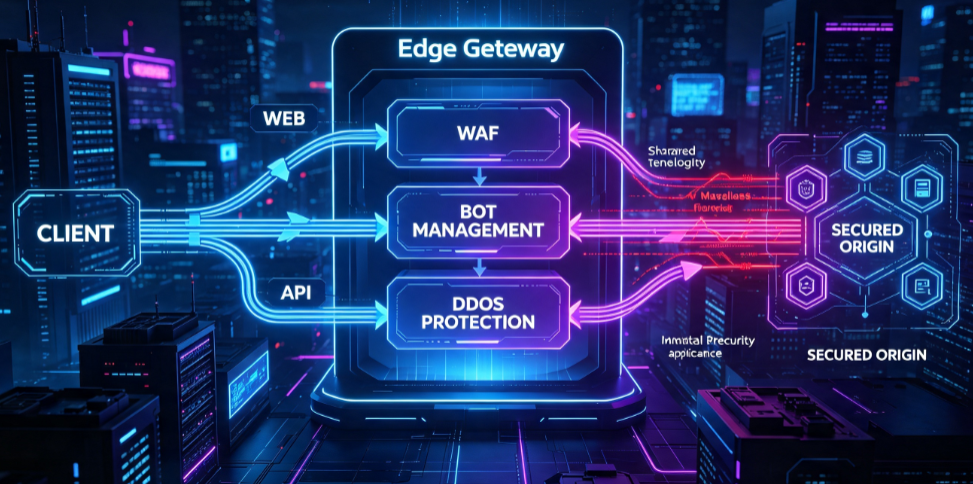
When a website comes under attack, it rarely faces a single threat in isolation. What reaches the application is usually a coordinated mix of malicious traffic: high-volume SYN and UDP floods at the network layer, an HTTP flood at the application layer, and automated clients hammering login, registration, search, checkout, or API endpoints with requests that appear legitimate. SQL injection, cross-site scripting (XSS), path traversal, and other exploit attempts may be buried in the same traffic stream.
Running DDoS protection, a web application firewall (WAF), and bot management as three separate systems can create a new set of problems. A DDoS service that rate-limits by IP may block legitimate users behind a shared gateway. A WAF may deny a request after spotting a suspicious parameter without knowing whether it came from a person, a trusted integration, or a malicious script. A bot management platform that sends every visitor a browser challenge may break mobile APIs, persistent game connections, and machine-to-machine traffic. Conflicting rules, fragmented logs, and duplicate enforcement ultimately weaken the overall defense.
This is the problem CDN07's integrated security architecture is designed to solve. The goal is not simply to bundle a DDoS-protected CDN, WAF, and bot management into one product. CDN07 uses a distributed edge network to place traffic routing, DDoS scrubbing, application request inspection, automated behavior detection, API security, and origin protection in one decision pipeline. Instead of evaluating and blocking traffic independently, the security layers share network indicators, request attributes, session state, and business context. The platform can then drop, rate-limit, challenge, block, monitor, or allow each request according to its risk level.
Why Modern Attacks Require Layer 4 and Layer 7 Coordination
DDoS protection first answers a basic question: can the service absorb the incoming traffic and stay online? When attackers consume bandwidth and connection capacity with large packet volumes, connection attempts, or malformed protocol traffic, the security platform must route and scrub that traffic before it approaches the origin. At this stage, the most important signals include packet rate, connection state, protocol validity, source distribution, and sudden traffic shifts. The objective is to remove invalid traffic quickly and prevent the attack from reaching the server.
A WAF answers a different question: does an individual HTTP request show malicious intent? It must understand the URL, request method, headers, cookies, parameters, and body to detect injection attacks, cross-site scripting, malicious file access, suspicious uploads, and other web threats. Even a low-volume request can exploit an application vulnerability and cause serious damage, so bandwidth alone cannot determine risk.
Bot management addresses a third problem: a request may be technically valid even when the way it is generated or the purpose behind it is abusive. Automated tools can use real browser engines, standard HTTP methods, and valid accounts to bypass static signatures. They can then carry out credential stuffing, mass account creation, content scraping, inventory hoarding, automated purchasing, and API abuse. The security system must evaluate not only what is in each request, but also who is making it, how it is being made, and what the requester does over time.
These three capabilities have distinct responsibilities, yet they rely on many of the same signals. An HTTP flood is both an application-layer DDoS attack and automated behavior. High-frequency login attempts may indicate credential stuffing and can also exhaust resources. A malicious crawler may carry no exploit payload but still consume search and database capacity. A realistic view of business risk requires Layer 4 traffic conditions, Layer 7 request semantics, and session behavior to be analyzed together.
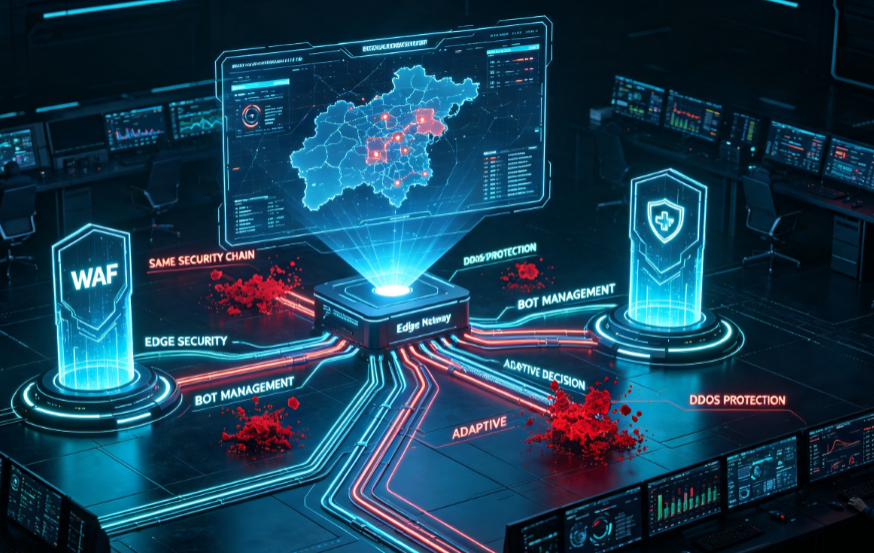
CDN07 Architecture: One Security Pipeline for DDoS Protection, WAF, and Bot Management
CDN07 first receives public traffic through its DDoS-protected CDN, then performs network scrubbing, protocol validation, application inspection, and behavioral analysis in stages at the edge. Only requests that meet policy requirements are forwarded to the origin. For gaming, cross-border e-commerce, online services, and high-concurrency APIs, this design moves security decisions closer to hostile traffic. The origin does not waste compute resources on obviously invalid connections, malicious payloads, or automated abuse.
The first layer is distributed ingress and traffic routing. User and attack traffic enter the CDN07 edge network, where the platform routes requests based on network conditions, node capacity, and visitor location. Distributed entry points prevent all traffic from converging on a single address and provide the capacity required for downstream scrubbing. Because acceleration and security share the same edge ingress, legitimate users do not need to detour through a separate scrubbing appliance before reaching the CDN. This reduces the routing complexity created by chaining multiple network services together.
The second layer handles network and protocol scrubbing. The system evaluates packets, connections, and protocol state to identify SYN floods, UDP floods, and other volumetric attacks. It also filters traffic using signals such as connection rate, handshake state, packet-size distribution, and unusual source patterns. Clearly invalid traffic or connections that violate protocol state can be dropped at this stage, before they reach more resource-intensive HTTP parsing and WAF inspection. This protects the backend and keeps massive volumes of useless traffic from overwhelming the Layer 7 engine.
The third layer provides HTTP and application security inspection. After requests pass the network-layer filters and enter Layer 7 processing, the WAF parses the method, path, parameters, headers, cookies, and body. It applies managed attack rules and custom business policies to identify risk. Confirmed exploit attempts can be blocked directly at the edge. Traffic that is suspicious only because of its rate, request sequence, or uncertain identity is not automatically denied; those signals are passed to bot management and risk controls for further evaluation.
The fourth layer identifies bots and abusive business behavior. CDN07's intelligent scrubbing approach correlates real-time traffic analysis, behavioral detection, and attack indicators. The system can combine request rate, navigation path, User-Agent, cookie state, protocol type, geographic origin, and activity over time to distinguish likely human visitors, known trusted programs, basic automation, and high-risk bots. In gaming and mobile app environments, device context, client state, and API behavior can also contribute to the risk assessment, so cloud-side decisions no longer depend on an IP address that an attacker can easily rotate.
The fifth layer controls access to the origin. Legitimate requests that pass the preceding checks are forwarded by edge nodes, while the origin is configured to accept traffic only from trusted origin-facing endpoints. Unnecessary public ports and legacy DNS records should be removed. This closes the loop across DDoS protection, WAF, and bot management: the edge identifies and handles threats, while origin access controls stop attackers from bypassing CDN07 and connecting to the server directly.
CDN07 Advantage #1: One Edge Entry Point for Security and Performance
A traditional architecture that combines a CDN, a separate DDoS mitigation service, and a standalone WAF sends traffic through multiple layers of DNS, proxies, scrubbing centers, and origin routing. It also makes configuration, certificate management, log correlation, and troubleshooting more complex. During an attack, each system may activate policies against a different traffic path.
CDN07 places acceleration and security at the same edge entry point. Under normal conditions, the platform caches content, selects network routes, and forwards requests. When an attack begins, it increases scrubbing and access-control enforcement on the traffic path already in use. Organizations avoid repeatedly changing DNS, switching addresses, or rebuilding connections before and during an incident. Security policies can also use the full request context already available at the CDN edge.
This advantage is especially important for WebSocket and other persistent-connection services. Unlike ordinary web requests, these sessions cannot always be retried without disruption. A policy based only on short-term connection counts can easily mistake healthy long-lived sessions for an attack. Combining network state, session duration, and application path makes it possible to protect resources without degrading the connection experience.
CDN07 Advantage #2: Multidimensional Risk Scoring Instead of Fixed Rules
Static rules are fast and predictable, but a single threshold is easy to defeat when bots closely imitate real users or application-layer DDoS and CC attacks change frequently. Dozens of requests per second from one IP might indicate an attack on a residential connection, but the same pattern may represent many legitimate users behind a corporate NAT, campus network, or mobile carrier gateway. Conversely, a distributed botnet can keep the request rate from each IP very low while overwhelming a login or search endpoint in aggregate.
CDN07 emphasizes the correlation of multiple signals. The platform can evaluate IP and subnet reputation, request rate, URL concentration, cookie continuity, request timing, page-resource loading patterns, session behavior, and historical attack indicators at the same time, then assign a risk level. The decision shifts from asking whether one rule matched to determining whether several anomalies point to the same behavior. Enforcement is therefore better aligned with how the application is actually used.
The key is to translate that risk assessment into graduated actions. Low-risk requests are allowed. Mild anomalies can be monitored or gently rate-limited. Suspicious browser traffic can receive a JavaScript check or human verification challenge. APIs and machine-to-machine traffic can be validated with tokens, signatures, client identity, and quotas. Only confirmed malicious payloads, protocol violations, and persistent abusive behavior are blocked outright. Progressive enforcement helps reduce false positives.
CDN07 Advantage #3: WAF Rules and Bot Policies Share Evidence
The most common conflict between a WAF and bot management occurs because both operate on application-layer traffic but apply different logic. The WAF focuses on request content, while bot management focuses on the requester and its behavior. If the two systems run in parallel without sharing results, a malicious bot may pass the WAF because its request looks normal, or evade bot detection by completing a simple challenge. Legitimate users may pass one verification step only to be blocked again by the other system.
In CDN07's coordinated pipeline, a WAF rule match can contribute to bot risk scoring, and bot behavior can influence the WAF response. For example, a request with possible injection indicators is clearly riskier when it also comes from an automated session that rapidly cycles through paths than when a legitimate form happens to include a sensitive character. Likewise, an authenticated partner API that triggers a general rate rule should not receive a permanent exemption from every security check. Any exception should be limited to approved hostnames, paths, methods, and time periods, while exploit-detection rules continue to apply.
This model requires explicit rule priority. Protocol violations and high-confidence attacks should be handled first. Business allowlists must have a narrow scope rather than act as a pass through every defense. Managed WAF rules, custom rules, bot policies, and endpoint rate limits should run in a defined order for each request path. Passing a challenge can lower a request's bot risk score, but it should never cause malicious parameters to be ignored. The three capabilities can work together only when the platform defines which layer evaluates first, which decisions can override others, and which results can be reused.
CDN07 Advantage #4: Different Responses for Websites, APIs, and Client Apps
Many false positives come from choosing the wrong response, not from identifying the wrong risk. A web browser can run JavaScript, store cookies, and support human interaction, while public APIs, payment callbacks, search engine crawlers, monitoring probes, and game clients may not. Sending a CAPTCHA to every suspicious request immediately breaks machine-to-machine calls. Disabling challenges to keep APIs available, however, leaves room for malicious automation.
CDN07 combines a DDoS-protected CDN, WAF, API security, and client-side signals to support response strategies tailored to each channel. Standard web pages can use cookie validation, browser challenges, and session behavior. Login, registration, SMS, and password-recovery endpoints can add account, device, token, and time-window rate controls. Public APIs can authenticate callers with keys, signatures, timestamps, source restrictions, and granular quotas. Gaming and mobile app services can also correlate the client runtime environment, device risk, and API request patterns.
Modeling protection by use case is more practical than assigning one security level to an entire site. Homepages and static assets should prioritize fast delivery. Login and payment flows need stricter identity and behavioral verification. Search and recommendation APIs need controls for expensive queries, while administrative paths should have a much narrower access scope. CDN07's customizable nodes, bandwidth, and security policies let organizations protect critical application paths without being locked into one threshold that cannot be tuned.
How Security Policies Escalate During an Attack Without Disrupting Real Users
A security policy needs more than two settings: normal operation and sitewide lockdown. A more effective approach defines baseline, alert, heightened-protection, and emergency states, with transitions driven by real traffic signals.
During normal operation, the CDN07 edge measures request rates, path distribution, protocol usage, and error rates to establish baselines for each hostname, endpoint, and time period. When anomalies appear, the platform applies more granular rate limits to expensive paths and determines whether the activity is concentrated around specific sessions, clients, or request patterns. If network traffic continues to rise, scrubbing becomes more aggressive. If request volume remains modest while origin resources degrade quickly, WAF, bot, and API policies prioritize protection for resource-intensive endpoints.
Even in an emergency, enforcement should reflect the needs of each application flow. High-confidence attack traffic is dropped, high-risk bots are blocked, and medium-risk browsers are challenged. Authenticated users and critical APIs remain available under tighter quotas, while static content is served from edge cache wherever possible. As the attack subsides, policies should return to normal in stages so restricted connections do not all retry at once and create another traffic spike.
CDN07's technical value in this process comes from allowing routing, scrubbing, WAF, and behavioral risk controls to share the state of the same attack. Source shifts detected at the network layer can prompt the application layer to adjust thresholds, while attack paths identified at the application layer can help the edge eliminate invalid connections more efficiently. Security teams no longer need to copy IP addresses and rules manually between consoles; the controls respond together around the same business objective.
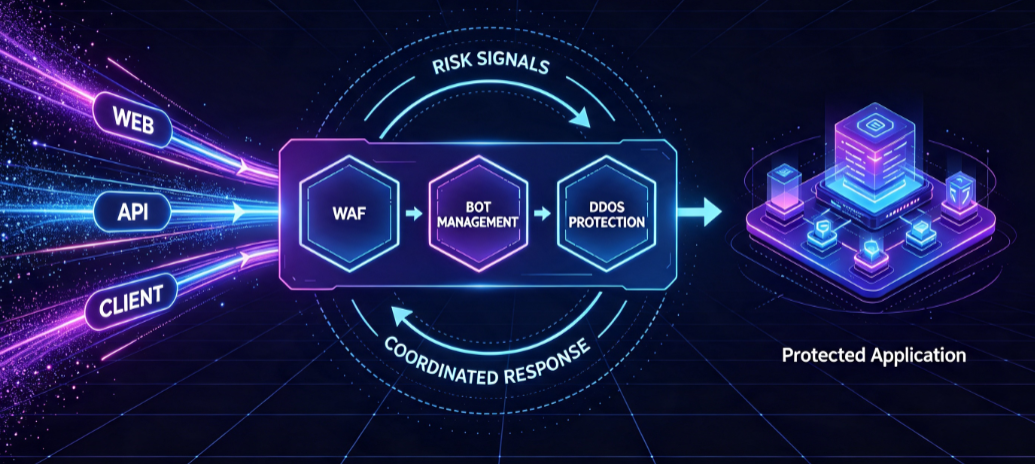
Balancing Security Effectiveness With User Experience
The effectiveness of a DDoS protection platform cannot be measured only by the number of blocked requests. A high block count may mean the attack was contained, but it may also indicate widespread false positives. More meaningful metrics include service availability during the attack, origin bandwidth and connection levels, success rates for critical endpoints, page and API latency, challenge completion rates, false-positive reports, impact on search indexing, and time required to return policies to normal.
CDN07's integrated acceleration and protection model brings these measurements into one application delivery path. Edge caching reduces requests to the origin. Network scrubbing removes invalid connections. The WAF blocks malicious payloads. Bot management limits automated abuse, and API policies protect resource-intensive endpoints. The modules are not competing for credit based on block counts; they work together to reduce origin load and keep legitimate users connected.
During production rollout, organizations can begin with WAF and bot policies in monitoring mode, then enable enforcement gradually by hostname, path, client, and user type. New rules should first cover a small share of traffic, with special attention to login, payment, callback, WebSocket, and mobile endpoints. Every adjustment should retain a version and clear rollback criteria. Coverage can expand after normal user journeys have been verified.
How Different Industries Use CDN07's Coordinated Protection
Gaming platforms may face simultaneous attacks against login gateways, update assets, gameplay APIs, and account systems. The DDoS-protected CDN absorbs network attacks and distributes content. WAF and API security protect login, payment, and operations endpoints, while bot management identifies mass registration, automated logins, and abnormal API calls. Where client integration is available, runtime context and device risk can also contribute to a more complete decision chain: client awareness, edge response, and cloud-based analysis.
In cross-border e-commerce, promotional traffic and attack traffic often arrive at the same time. Simple traffic-rate limits can block real shoppers, while unrestricted access allows scrapers, credential-stuffing tools, and inventory-hoarding bots to slow the platform. CDN07 can apply separate policies to the homepage, product pages, search, login, cart, and checkout APIs. Static assets are cached first, search controls expensive anomalous queries, login detects automated attempts, checkout evaluates session behavior and request rate, and payment callbacks require strict source and signature validation.
For content, livestreaming, and media platforms, legitimate search crawlers, authorized partner feeds, and malicious scrapers can generate similar-looking requests. CDN07 first reduces origin load through edge delivery, then uses bot classification, request quotas, and path-specific policies to distinguish search engines, partners, and unauthorized automation. This helps balance discoverability, partner distribution, and content protection.
In financial services and high-value API environments, the business risk from one request may far exceed its bandwidth cost. In addition to DDoS protection and WAF controls, organizations should strengthen identity verification, request signing, replay protection, account-behavior analysis, and endpoint authorization. CDN07's integrated pipeline can filter abnormal access at the network and application edge, but transaction authorization, data validation, and business risk decisions still belong in the application. Edge security and application security must work together as defense in depth.
Integration Clarifies Security Boundaries - It Does Not Eliminate Them
Coordinating DDoS protection, WAF, and bot management does not mean any one capability can replace the rest of the security program. A WAF can block common attacks, but it cannot replace secure coding, dependency updates, or vulnerability remediation. Bot management can identify automation, but it cannot replace account security, transaction risk controls, or authorization. A DDoS-protected CDN can absorb and scrub attack traffic, but it cannot compensate for an origin IP that remains exposed, unnecessary origin ports left open, or leaked credentials.
The real benefit of integration is a clearer responsibility for every layer. DDoS protection preserves network and connection capacity. The WAF identifies malicious intent within requests. Bot management detects automation and business abuse. API and client security add identity and device context. Origin access controls prevent attackers from bypassing the edge. The layers share signals while retaining distinct decision boundaries.
Moving From a Stack of Products to Coordinated Security Decisions
Against blended attacks, organizations do not simply need more isolated security appliances. They need a decision system that understands where traffic comes from, what it is trying to access, how it behaves over time, and what impact it may have on the business.
CDN07's advantage is its use of a distributed DDoS-protected CDN as the entry point connecting DDoS scrubbing, WAF, bot management, API security, intelligent routing, and origin protection. Obvious network attacks are reduced immediately at the edge. Malicious requests are identified at the application layer. Automated abuse receives a response tailored to behavior and identity, while legitimate traffic continues to benefit from caching, acceleration, and stable origin connectivity. Security becomes part of business continuity rather than a simple blocking mechanism.
The effectiveness of WAF, bot management, and DDoS protection is not determined by how many product names appear in the stack. It depends on whether all three make consistent decisions in support of the same business goal. Network and application layers must share signals. Rules need a clear order of priority. Websites, APIs, and client apps should use verification methods suited to their capabilities. Results should be measured by real user experience and origin stability. This is the principle behind CDN07's integrated security architecture: edge coordination, layered detection, and dynamic policies protect the application entry point as attacks evolve, while legitimate users retain a fast, reliable, and sustainable path to the service.
Share this post:
Related Posts

How to Choose a DDoS-Protected CDN for Mainland China: Speed and Security Guide
How can websites hosted overseas improve access from Mainland China without compromising DDoS protec...

What to Do When Your Website Is Slow: A Practical Guide to Troubleshooting DNS, TTFB, and Resource Loading
Why is your website slow to load? This guide walks through DNS resolution, connection setup, TTFB, i...

Why Online Card and Board Games Need an SDK-Based Game Shield for DDoS Protection
Online card and board games face persistent security risks, including DDoS attacks, HTTP floods, che...